Who in the school district owns MTSS? It’s a question someone recently asked me.
First off, MTSS (multi-tiered systems of supports) is a framework that relies on data to meet the needs of each student. Educators align themselves to frameworks, and ideally, in a high-functioning district all educators are aligning to MTSS. Thus, it’s tempting to say that “everyone owns MTSS!”
End of discussion, right?
But let’s be real. We know that when everyone owns something, the finer details of implementation get lost.
This is why there need to be assigned leaders and implementation teams responsible for “making MTSS happen.” Specifically, there should be a designated leader of MTSS within your district and at the school level. There should be a district implementation team and schoolwide teams with a built-in mechanism to share information across levels.
Why Assign a Designated Leader of MTSS?
Creating a role to lead MTSS will advance the work. This role ensures district-wide coherence of MTSS. They lead the creation of a district-wide process to support students through academic, behavioral, and social and emotional learning (SEL) interventions.
I’ve seen scenarios where individual schools determine their own thresholds to identify when students are at risk or develop their own information to explain the MTSS process to families. These functions can be developed once by central office for schools to use—rather than having individual school leaders spend hours of their valuable time only to create something that leads to inconsistent practices across the district.
The MTSS lead can live within the Teaching and Learning department or in some cases with Student Supports. Critically, it should not live solely with Special Education as this signals that MTSS is not for all students.
The most vital part of this role is that the MTSS lead has a strong capacity to work across academic, behavior, and SEL domains. They must know how to persuade others, managing by influence, as in many cases they may not have direct authority over everyone on their implementation team. This is especially the case for larger districts.
Why Implementation Teams?
An MTSS implementation team is vital and backed by research. For example, with competent implementation teams’ support:
- Over 80% of attempted implementation sites used practices with fidelity
- Without effective and efficient implementation teams, only 30% met fidelity criteria
SOURCE: Fixsen, Blase, Timbers, & Wolf, 2001
These authors also found that implementation teams contributed to increased success and efficiency, with the time required to achieve fidelity reduced from 7 to 3.6 years. These teams should be organized at the district and school levels.
The District MTSS Team
The district MTSS team should think of their role as setting up systems that can scale to support schools. They provide guidance, visibility, funding, and political support. This team should be responsible for selecting and rolling out any technology system-wide that supports MTSS. This team should include district administration, school administration and ideally, teacher leader representation.
Schoolwide MTSS Team
School level teams are responsible for the details of implementation within their own buildings. For example, they should orchestrate when, who, and how grade or content team meetings are run to support MTSS. They should do the same with school-wide meetings.
Ideally, the district-wide team has set up guidelines and protocols that schools can use or refine. These teams are typically represented by an administrator, general and special education teachers, and other interventionists or service providers.
The main point is that while just about every educator should align themselves to the MTSS framework, it will be a leader, who shares ownership with implementation teams, that actually makes MTSS happen.
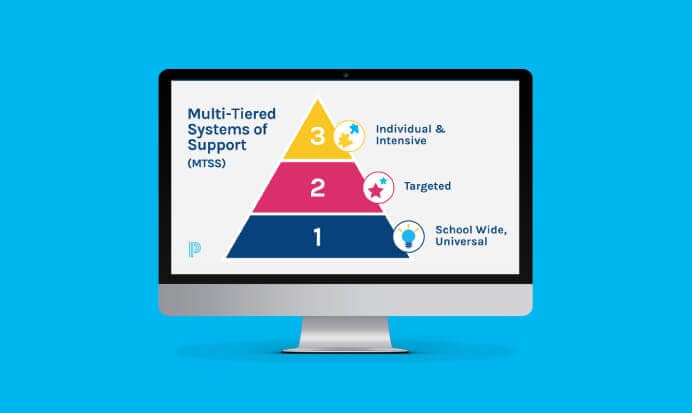
Data-Driven MTSS: Best Practices and Strategies for Implementation
Watch the on-demand webinar to hear from industry experts how data can drive your tiered instruction and support your MTSS framework.
Watch Now