
By Trip Kucera, PowerSchool Vice President, Innovation & Research
Today, K-12 districts are seizing opportunities to drive positive change through technology and data. Developed in collaboration with the national education nonprofit Project Tomorrow®, PowerSchool’s 2026 K-12 EdTech Pulse (formerly the PowerSchool Education Focus Report) offers a comprehensive look at these new opportunities. Specifically, the report reveals how educators at all levels are adopting edtech solutions to:
- Support student success and learning
- Enhance teacher effectiveness
- Actively engage families in their child’s education
- Improve district resource planning
Grounded in input from more than 1,300 teachers, administrators, and industry leaders, the K-12 EdTech Pulse identifies some of the biggest K-12 challenges, including staffing shortages, tight budgets, evolving family expectations, and lingering impacts from the pandemic. The report largely focuses on how leaders can or are already leveraging technology and data to solve these challenges and plan for a future that supports every learner.
Meeting modern learners where they are
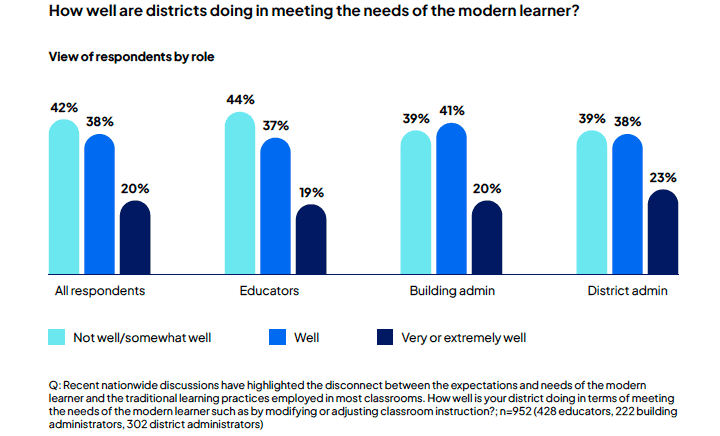
A central theme of the 2026 report is the disconnect between the expectations of the “modern learner” and traditional classroom practices. Today’s students often seek learning experiences that replicate the self-directed, technology-rich environments they encounter outside of school. However, survey results indicate a gap in delivery: only one in five respondents say their district is doing very or extremely well in meeting the needs of the modern learner.
To bridge this gap, districts are turning to data-driven frameworks. Multi-tiered systems of supports (MTSS) have become an integral part of student intervention strategies. Fifty-eight percent of MTSS users say their leadership now have access to data that validates the effectiveness of these interventions, allowing for more targeted and successful support systems.
Attendance remains a critical piece of the student success puzzle. When asked about high-impact strategies for increasing attendance, 60% of educators identified creating a positive school climate as the most effective approach, followed closely by building meaningful relationships with students (52%). Additionally, technology is playing a growing role in career preparation. Thirty-six percent of respondents say educators in their district are already using AI to support students with work-based learning plans, helping to align classroom instruction with future career aspirations.
Transforming how we support teachers
The role of the classroom educator has expanded significantly, encompassing responsibilities that extend far beyond instruction. This increase in workload, coupled with challenges in recruiting and retaining high-quality staff, has made teacher effectiveness a top priority for district leaders. The report reveals a strong belief in the potential of artificial intelligence to alleviate these burdens and enhance teaching practices.
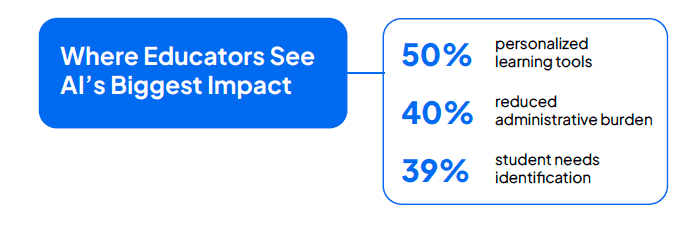
Half of the educators surveyed believe AI tools that personalize learning will have the most significant impact on their effectiveness over the next two to four years. Beyond instruction, AI is serving as a productivity multiplier. Fifty-seven percent of respondents report that educators and administrators are already using AI to create drafts and emails, while 46% say educators are using AI to research lesson plans. These efficiencies grant teachers more time to focus on student interactions and instructional quality.
“As Director of Curriculum, Instruction, and Digital Learning for Chicago Public Schools (CPS), I witnessed firsthand how technology—when implemented strategically—can transform both
operational efficiency and instructional effectiveness,” says Tim Clark, Vice President, K-12 Programs, 1EdTech. “Today, using a large language model within a digital curriculum, CPS is enabling teachers to use AI safely and effectively to search for lesson plans and instructional resources. The system can also suggest learning materials tailored to students’ individual needs… The result has been a measurable improvement in both efficiency and adaptability. This model shows how an intentional use of open standards, data interoperability, and AI can help large districts build resilient, scalable, and future-ready educational systems that directly benefit both educators and learners.”
Professional learning is also evolving. Nearly half of respondents (48%) believe that aggregating student data outcomes and connecting them to professional objectives would significantly benefit job-embedded coaching. This data-informed approach allows for more personalized mentorship, helping teachers grow in their practice while feeling supported by their districts.
Building stronger connections with families
Parental perspectives on schooling are shifting, requiring districts to adopt new strategies for engagement. The report highlights that effective communication is no longer just about pushing information out; it is about meeting families where they are. Consistency is paramount, with 68% of educators and administrators prioritizing consistent communication via newsletters and apps.
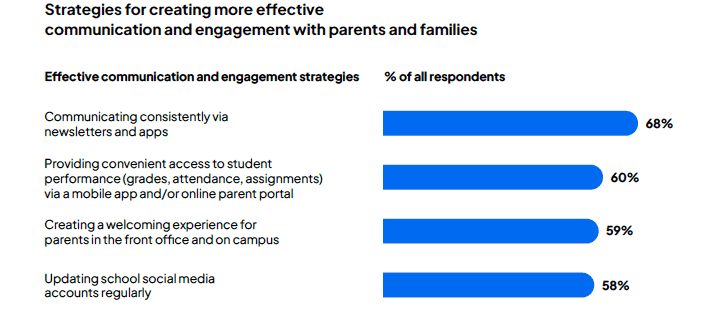
Mobile accessibility is also a key factor in keeping families informed. Sixty percent of respondents leverage mobile apps and portals to provide convenient access to student performance data. When it comes to timely interventions, district administrators identified attendance notifications (78%) as the most helpful alert type, followed by academic performance (69%).
Districts are also finding new ways to tell their stories to attract and retain families. Fifty-two percent of schools are optimizing their websites to increase visibility, while 50% promote achievements across online channels. A smaller segment of innovative districts (18%) is taking engagement a step further by utilizing school ambassadors within parent social media communities.
Budgeting for highest needs and reimagining enrollment strategies
Financial uncertainty has emerged as the number one challenge for district leaders in this year’s report. Faced with political unknowns, economic fluctuations, and declining enrollment, administrators must make difficult decisions to balance their budgets while protecting core instruction.
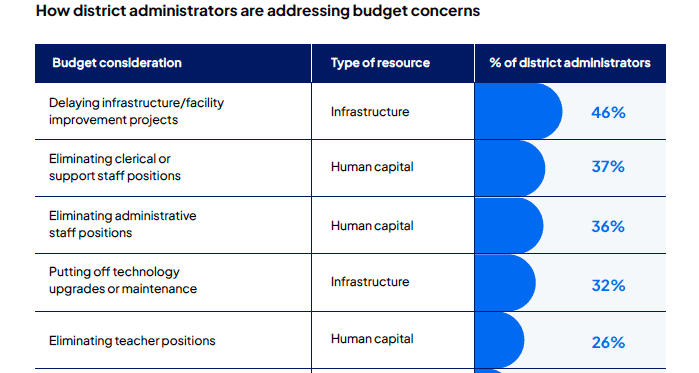
Forty-four percent (44%) of district administrators state that strategically budgeting to maximize limited resources is a primary objective. When funding decreases, leaders are forced to prioritize. The report shows that 46% of administrators are considering delaying infrastructure projects to avoid cuts in other areas. Leaders are working hard to protect human capital, with fewer administrators considering cuts to instructional staff (26%) compared to other areas.
Because enrollment ultimately impacts a district’s bottom line, many districts are leveraging technology to market themselves and attract more families to their schools. In addition to traditional outreach approaches like website optimization and social media, some forward-thinking districts are getting creative with family recruitment and retention efforts:
- Using data-infused strategies to help identify parents who would be most interested in their unique programs (17%).
- Providing personalized learning platforms tailored to individual student needs (20%).
- Demonstrating their commitment to innovation through stories about classroom technology use (23%).
About the K-12 EdTech Pulse
The 2026 K-12 EdTech Pulse represents a significant collaborative effort between PowerSchool and Project Tomorrow®. The findings are based on a mixed-methods data collection process designed to uncover authentic insights from the field.
Data for the report was collected through a national online survey administered in October 2025, gathering quantitative feedback from 1,327 classroom educators, school building administrators, and district administrators. This quantitative data was augmented by qualitative feedback from small virtual discussion roundtables and one-on-one interviews with national education thought leaders. This rigorous methodology ensures that the report reflects the true voices and experiences of those on the front lines of education.
Moving from fragmentation to coherence
As K-12 education faces lingering questions about the long-tail impact of AI and financial instability, the need for a coherent, system-wide vision has never been greater. The insights from the 2026 K-12 EdTech Pulse provide a roadmap for leaders to move from fragmentation to alignment, using technology not just as a tool, but as a catalyst for transformation.
Read the full 2026 K-12 EdTech Pulse to explore innovative tech strategies defining the future of education.
2026 K-12 EdTech Pulse
Find out what education leaders are thinking, planning, and prioritizing now.
Read It Now