Some educators are hesitant to embrace artificial intelligence (AI) and machine learning in education because they fear what they perceive to be the unknown. Based on a lifetime of human-led instruction, they may not trust AI’s ability to help the teacher truly know their students, and they aren’t comfortable with the misplaced thought of computers taking away some of their decision-making.
Communities sometimes fear automatic categorization of students because they feel it may bias groups of people. And it’s been proven that the risk of data bias or algorithmic bias can be perceived by all stakeholders as discriminatory.
At the same time, some instructors worry that relying too much on AI systems might compromise the student’s ability to learn independently, solve problems creatively, and think critically. Another concern of AI is letting algorithms put labels on kids such as “at-risk.”
And finally, students and families may perceive indiscriminate collection and analysis of their data through AI systems as a privacy breach.
However, not all AI is the same. We can have AI with a conscience, so it’s a partnership between educators and advanced digital tools. One thing to make clear is that we are not suggesting that educators should make decisions solely based on technology alone—such as an algorithm or computer. Students should not be subjected to decisions based solely on automated processing without any human intervention.
In education, AI can fit in with school and district frameworks of expectations. Bias elimination needs to be built-into the models and algorithms by letting data tell the story and having a fairer approach to using data to support students.
In this blog, we’ll look at how AI can improve student outcomes while enhancing equity with an unbiased approach to serving students.
What Is Artificial Intelligence, Predictive Analytics, and Machine Learning?
Artificial intelligence uses data to make recommendations. An example is when you’re using Netflix, you receive viewing suggestions based on previously collected data: your watch history.
Predictive analytics is a subset of AI, using a statistics-based method to make assumptions and test records to predict the likelihood of a possible outcome. Predictive analytics relies on people interacting with data to identify trends and test assumptions.
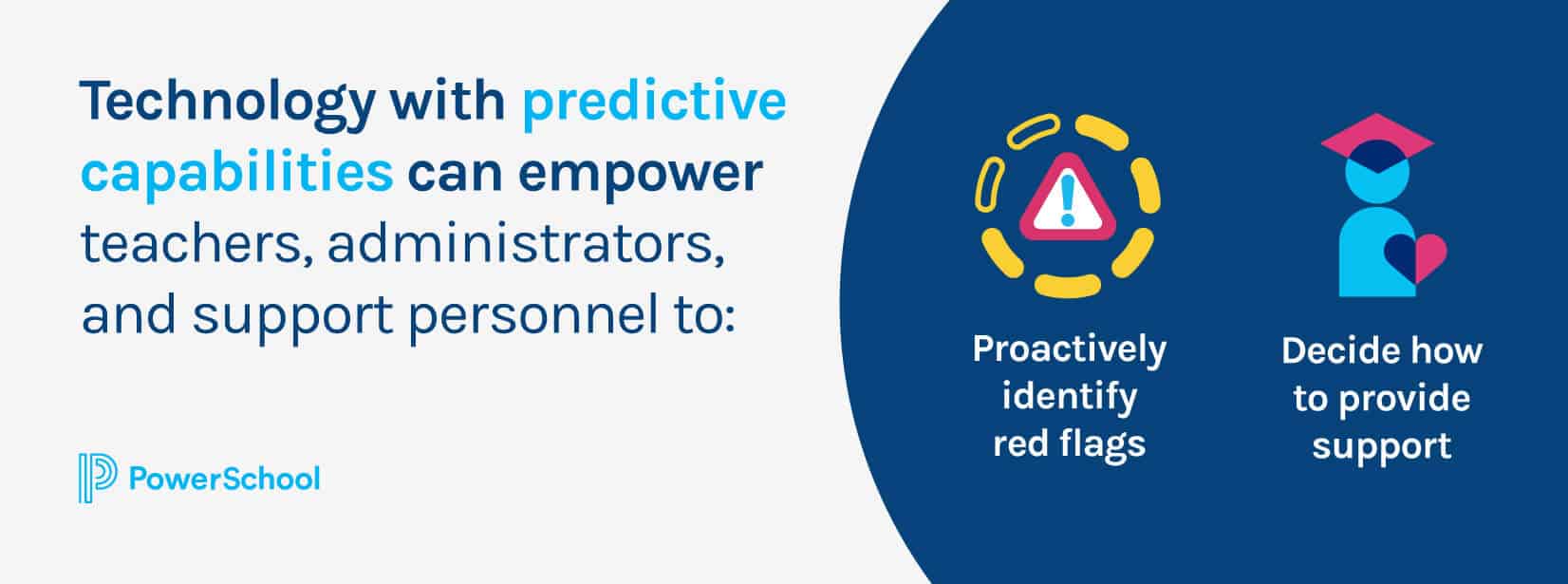
Technology with predictive capabilities transforms education data—like assessment results, grades, attendance, and behavior incidents—into actionable information. It can empower teachers, administrators, and support personnel to proactively identify red flags and decide how to provide support.
An example is PowerSchool Risk Analysis, which uses data to forecast and identify students at risk of not graduating or failing to graduate on time. The product looks at probabilities and likelihood to make recommendations or predictions, but not final decisions. Its recommended use is as a screener. The proposed use is to screen students for risk through the modeling and prediction of on-time high school graduation.
The ultimate decision-making authority of which students receive intervention is made by staff at the school or district. Because no prediction is perfect, the design necessitates a “human in the loop” for informed decision-making.
Machine learning uses historical data sets and identifies potentially related variables to discern patterns that predict future outcomes. Machine learning solutions don’t collect data for data’s sake. They look for relationships that can be molded into actionable insights. These deeper insights address the more complex factors that make up a student’s experience.
At PowerSchool, we only use de-identified data for any AI or machine learning modeling.
Machine learning reveals nuanced insights that educators otherwise might not have the resources to identify, allowing them to see more quickly which students need support and to what extent.
How AI is Using Data to Improve Education
Artificial intelligence is already using data to make helpful recommendations for us every day. The example of Netflix above highlights this reality. In education, AI systems offer effective support for online learning and teaching, including personalizing learning for students, automating instructors’ routine tasks, and powering adaptive assessments.
Examples of how AI assists teachers in education include:
- Adaptive quizzes that get harder or easier based on previous answers and results, and recommend resources
- Proactive identification of student needs based on “similar student characteristics”
- AI teaching assistants where AI answers questions in the chat during a lecture based on questions and answers given in the past, and when a student asks a unique question, the AI redirects it to the instructor
- AI grading assistance where AI provides grading suggestions for the teacher or teacher assistant while they mark tests
The K-12 education field uses machine learning to fuel the paradigm shift toward interdisciplinarity, student risk analysis, intervention systems, and overall student achievement. Predictive technology gathers, analyzes, and reports data about each student, which helps improve student outcomes from the top down.
For example, PowerSchool Connected Intelligence K-12 brings AI to PowerSchool solutions. As the first fully managed data as a service platform for K-12, it provides a means for schools and districts to manage student data and leverage that information to make the most informed decisions.
By using data, we’re eliminating inequities by painting a complete picture of the whole child, one that gives educators and administrators the ability to see each one as an individual.
“In districts and schools with data cultures, educators learn how to use data properly to enhance learning rather than misuse it by turning it into something punitive. And importantly, they discover how to use data to build a picture of a whole child, one that is more than just a number,” says Thomas C. Murray, Director of Innovation for Future Ready Schools.
PowerSchool solutions follow school and district specific framework. With PowerSchool products, the teacher is always in control, but they don’t have to power every aspect of a student’s learning. PowerSchool automates the process of gathering relevant data and supports the teacher in using that data to make critical decisions to help students.
How PowerSchool Solutions Use “AI with a Conscience”
The goal of AI in education is not to reinvent K-12, but rather to provide additional tools and resources to make the best recommendations and find the best pathways for students.
“When districts see each student as an individual with their own needs, aspirations, and challenges, then they’re better positioned to address equity issues they’ve been working on for years,” say Evo Popoff and Liz Cohen, education advisors.
PowerSchool solutions do not inherently make decisions for educators. Instead, we provide the opportunity for schools and districts to put students on the appropriate learning path based on student data collected within our solutions.
PowerSchool isn’t using AI to restrict students to a specific group or profile. We don’t create the models that categorize students, but instead provide teachers with tools so schools can put their frameworks into place.
AI Capabilities PowerSchool is Working On or Considering in Products:
PowerSchool tools support equity by giving schools and districts better access to a wide array of data about the whole child. We broaden access to multiple data points as opposed to limited data insight that may unfairly bias a student’s learning path.
Examples of AI in PowerSchool products include identifying students who are at risk of graduating or graduating on time—available now in PowerSchool Risk Analysis. New AI functionality will be coming to PowerSchool Analytics & Insights and PowerSchool classroom products in 2023.
Supporting Teachers with Valuable Data
While there may long be fears about using AI in education that it takes away from the teachers’ role or that it will bias groups of people, AI can fit in the framework of your expectations. AI can work to eliminate biases and ensure you take a fairer approach by letting data accurately tell the story.
PowerSchool tools do not eliminate a teacher’s role or importance. Instead, they give them power in the form of valuable data to make sound decisions.

PowerSchool Connected Intelligence K-12
Find out how Connected Intelligence K-12 helps education agencies make the most efficient and effective use of their data with the power to improve student outcomes and create pathways to social mobility.
Learn More