From short cooking videos to gamified language-learning apps, we’ve grown accustomed to learning from bite-sized lessons. There are countless benefits of microlearning, like higher engagement during lessons and better retention of its materials. In this blog, we’ll take a closer look at how micolearning works.
What is microlearning and why does it matter in education?
Microlearning is the practice of delivering lessons in short, focused bursts rather than long sessions. Instead of overwhelming learners with dense material, microlearning breaks complex subjects into digestible segments that can be completed in just a few minutes. A student reviewing vocabulary cards during a bus ride or exploring a short instructional video between classes is engaging in microlearning.
The approach is grounded in psychologist Hermann Ebbinghaus’ Forgetting Curve, which illustrates how quickly knowledge fades when it isn’t reinforced. Research shows learners typically forget up to half of new information within days if it isn’t revisited.
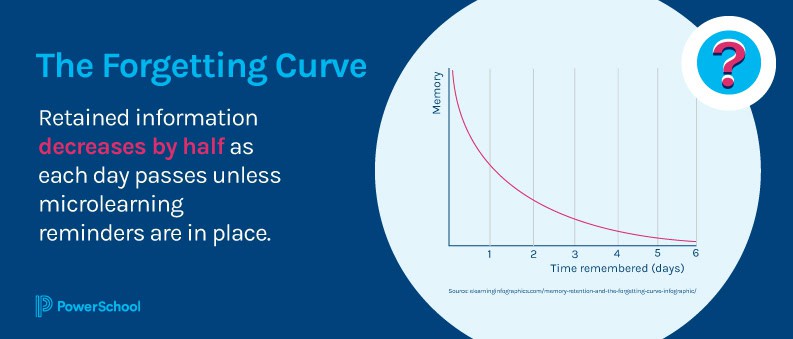
Microlearning counteracts this drop by presenting bite-sized lessons and then strategically refreshing learners on main concepts. This method helps information “stick” more effectively and supports long-term retention.
Digital tools now make microlearning more dynamic, helping students to re-engage with key concepts at the right moment—whether they’re in the classroom, at home, or on the go. The result is higher engagement and a smoother pathway toward positive learning outcomes and academic mastery.

Get the right tools for student success
Improve student outcomes with our microlearning-based solutions.
Learn MoreMicrolearning in education
Microlearning is reshaping learning by making knowledge more accessible for teachers and students. Instead of tackling complex subjects all at once, lessons are delivered in short, focused segments that are easier to absorb and apply. This streamlined approach not only supports stronger engagement but also drives measurable gains in retention.
Examples of microlearning
Digital tools for microlearning are all around us. They include apps with short interactive lessons, software with gamified quizzes, or AI-driven notifications and reminders spaced over time.
Microlearning games are most effective when students are able to apply new learning interactively. Simple memory challenges and puzzle-solving activities are among the most common types of microlearning that reinforce key vocabulary and concepts.
- A student reviewing vocabulary cards during a bus ride or exploring a short instructional video between classes is engaging in microlearning.
- A high school chemistry student might watch a brief animated video to demonstrate molecular bonding, followed by an interactive simulation where they can manipulate various elements to observe chemical reactions in real-time.
Mini-Games for microlearning
Games work most effectively when they require students to apply newly learned concepts in interactive ways rather than serving as disconnected rewards. Gamification elements, such as points and progress tracking, can motivate continued learning while providing immediate feedback on student achievement. For elementary students learning fractions, a module might include a brief game where they race to match equivalent fractions, immediately reinforcing mathematical concepts while maintaining engagement through visual rewards.
Benefits of microlearning
Microlearning capitalizes on how the brain naturally processes and retains information. Here are some key benefits:
-
Enhanced knowledge retention
This is microlearning’s most compelling advantage. When learners encounter information in concentrated portions, they experience reduced cognitive overload—a principle rooted in Cognitive Load Theory. Research by RPS Research demonstrates that microlearning enhances retention by 80%, compared to traditional methods, with knowledge transfer proving 17% more efficient, according to Shift Learning research.
-
Improved engagement
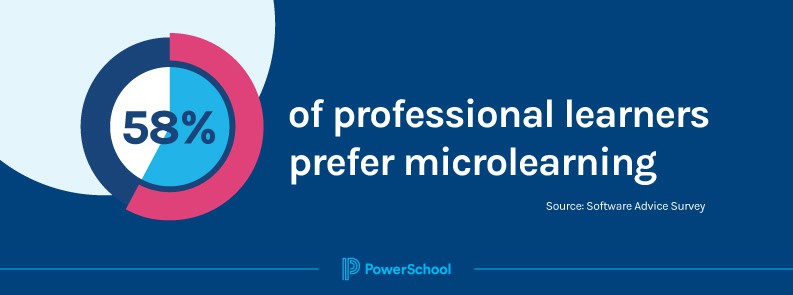
Engagement flourishes within microlearning environments through interactive, mobile-accessible experiences that capture and sustain attention. The approach keeps learners energized and motivated, avoiding the fatigue associated with lengthy training sessions. In fact, 58% of learners prefer shorter gamified opportunities.

Get the right tools for student success
Quickly generate questions, passages, and other content.
Learn More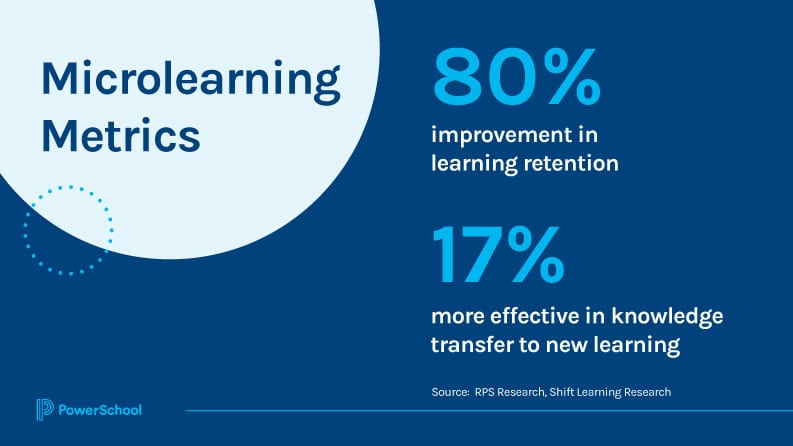
Microlearning vs Traditional Learning
Compared to traditional long-form instruction, microlearning reduces cognitive overload, improves efficiency, and supports stronger long-term retention. Research shows microlearning improves retention by 80% compared to traditional methods, while also being 17% more efficient in knowledge transfer.
Additionally, personalization becomes much easier through microlearning. Educational leaders can recommend or assign specific micro-courses that target individual skill gaps, creating customized learning pathways for each educator or student. This targeted approach ensures that development addresses genuine needs rather than applying generic solutions to diverse challenges.
Microlearning Best Practices
When thinking about microlearning best practices, a lot of successful solutions follow the modality principle to combine visuals with narration rather than overwhelming learners with long copy or audio. Short videos are the key to maximizing engagement within students’ attention spans.
Interactive design including infographics, animations, and simulations can explain complex concepts more effectively than static text alone. Ideally, content is optimized for mobile devices since many students access learning materials on tablets and smartphones.
Scenario-based learning connects abstract concepts to real-world scenarios, making microlearning content more memorable for K-12 students. Effective scenarios present authentic problems that students might encounter in their daily lives or future careers, encouraging critical thinking and problem-solving skills. Stories and characters can make scenarios more engaging for younger learners while maintaining educational rigor.
For middle school students learning about environmental science, a module might present a scenario about water conservation in their community, asking them to analyze data, consider multiple perspectives, and propose solutions while receiving feedback on their reasoning.
One topic, one module is an approach that supports better knowledge retention by allowing learners to focus on a single concept before moving forward. This focused structure aligns with the segmenting principle, enabling students to master one skill completely rather than partially learning multiple concepts.
Clear learning objectives should be established at the beginning of the module, while related concepts can be addressed in separate modules that build upon each other, creating learning pathways that scaffold student understanding over time. Assessment should directly measure the specific objective addressed in each module, providing clear feedback on mastery of the material.
Adapt length is key. Well-designed interactive quiz elements should contain fewer than 20 questions and aim toward pass rates of 80% or higher—keeping students motivated while accurately assessing comprehension. Quick knowledge checks can appear throughout modules to gauge understanding and course-correct right away. When games are integrated, they should support learning objectives.
For example, a social studies module on ancient civilizations might include an interactive timeline where students drag events to their correct chronological positions, receiving immediate feedback on historical sequences and cause-and-effect relationships.
Essentialism is an approach to eliminating extraneous information while preserving core concepts.
For K-12 learners especially, essentialist design means turning complex topics into bit-size lessons that build systematically, creating a foundation of understanding for deeper learning over time.
Conciseness and simple, direct language works alongside visuals to support learning. Research on multimedia learning principles shows that students learn best from a simultaneous combination of text and imagery. This reduces mental effort.
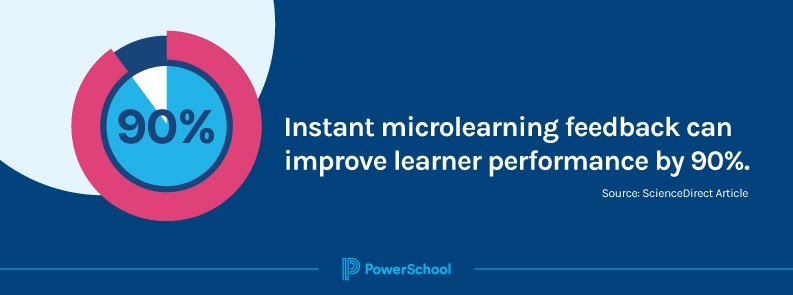
Bridging the gap between knowledge acquisition and practical application helps to create opportunities for immediate use of new concepts. In short, knowledge is more meaningful when students can apply what they’ve learned.
Research shows that applying new learning helps with knowledge retention. For K-12 educators, this means designing lessons that conclude with concrete next steps, whether that’s solving a practice problem or explaining the concept to a student peer.
Making every lesson relatable to students’ real lives increases engagement naturally because learners can see the immediate value of their effort. In the classroom, this means that students’ learning modules refer to familiar examples, address current learning challenges, and clearly articulate how new knowledge connects to students’ academic success.
Engagement: Capturing and maintaining attention can be done by leveraging a variety of content formats to appeal to various types of learners.
In short, microlearning best practices include gamification elements like progress indicators, achievement badges, or friendly competitions that motivate continued participation. Microlearning is a shift toward learning outcomes that honor both human cognitive limitations and the practical realities of educational environments.