For educators, artificial intelligence (AI) offers vast potential to enhance learning, simplify administrative tasks, and create more personalized, accessible educational experiences. According to a Forbes Advisor survey, 60% of educators are already using AI for their classrooms. But the pace at which AI has arrived on the scene—and the speed at which it continues to evolve—has left many teachers feeling overwhelmed and uncertain.
With a flood of new tools and limited guidelines from leadership, it’s understandable that educators may feel they’re playing catch-up. Despite a May 2023 report from the Department of Education acknowledging “the clear need for sharing knowledge and developing policies for Artificial Intelligence,” formal training on AI tools is not yet commonplace in schools. Naturally, it can be challenging for teachers to know where to begin.
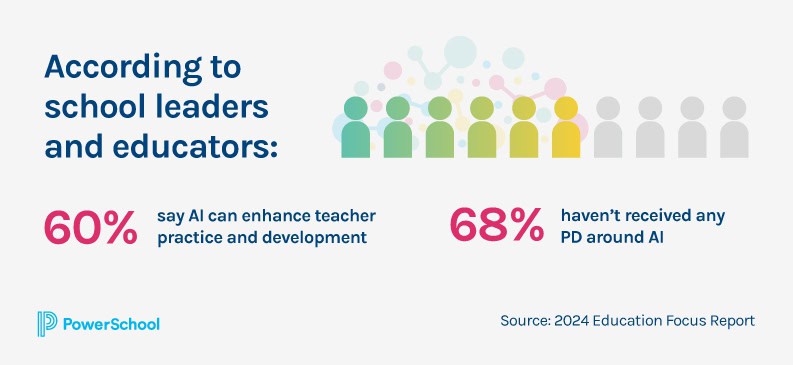
According to the 2024 Education Focus Report, 60% of school leaders and educators indicated that AI can enhance teacher practice and development, yet 68% reported that they hadn’t received any professional development around AI.
The good news? Teachers don’t need to become AI experts overnight. Instead, they can develop their AI literacy by exploring best practices and experimenting with tools already available within K-12 software. Adopting AI doesn’t have to be daunting; it’s about building a basic understanding and learning over time what works best for each teacher. When used effectively, AI should simplify and reduce a teacher’s workload, leaving educators with more time and energy to tap into their creativity and focus on the areas where they have the greatest impact.
This blog equips educators with the knowledge to begin incorporating AI into the classroom thoughtfully and effectively. We also look at some powerful yet easy-to-use AI tools designed to help K-12 educators put AI best practices into action.
3 Best Practices for Educators Using AI
If used strategically and responsibly, AI can bring tremendous benefits to K-12 education. Educators who study and align with AI best practices like the ones listed below will be best positioned to unlock its potential for their students.
1. Focus on Pedagogical Value
Start with Educational Goals: The use of AI tools in the classroom should first and foremost always align with educational goals and curricula. The best AI tools help students achieve meaningful outcomes by supplementing—not replacing—what teachers are already doing. By using AI tools to enhance lesson plans and achieve learning objectives, teachers ensure that AI serves a clear purpose rather than acts as an added distraction.
Utilize AI-Powered Feedback and Adaptation: When a student is struggling with a concept, AI can provide targeted support and content adapted to their interests and needs—all without placing additional burden on the teacher. For students ready to move ahead, AI can present more challenging tasks and ideas, so that each child moves at their own pace. As AI tools uncover student strengths and learning preferences, teachers also gain access to these valuable insights, informing strategies for each child and classroom.
Strike a Balance: Having students use AI for learning is most effective when combined with other tried-and-true methods. Incorporating collaborative, project-based, and experiential learning alongside AI helps students not only understand concepts more deeply but also build skills like teamwork, critical thinking, and problem-solving. By blending AI with hands-on, social learning experiences, educators can create a more well-balanced and enriching environment.
2. Ensure Equity and Accessibility
Accommodate Diverse Needs: Teachers can use AI tools to adapt content and instructional methods for students with a range of abilities and learning needs. This adaptability allows educators to create more inclusive classrooms where every student has a path to success.
Provide Equal Access: AI technology can help equalize the attention and support available to students. In particular, intelligent tutoring systems that supplement classroom instruction can alleviate systemic inequities by making personalized support a reality for all.
Mitigate Bias: AI systems have the potential to reflect or reinforce biases, so it’s important to have a plan for monitoring systems for biases and working with the technology provider or an administrator to take corrective actions.
3. Maintain Human Oversight
Augment, Don’t Replace: AI is at its best when it augments the expertise of educators, not when it is a substitute for the human interaction and professional judgment central to teaching. Teachers bring a deep understanding of their students’ needs, emotions, and abilities—and how these can vary day-by-day—that AI cannot fully replicate.
Maintain a Watchful Eye: Even the most advanced AI tools can produce errors or information that lacks context. By regularly checking on these tools, teachers can identify issues early and make adjustments as needed.
Commit to Continued Learning: As what’s possible with AI continues to grow, so does the importance of AI literacy. Understanding not only how to use AI tools but also their limitations will help educators take a balanced approach that leverages the strengths of technology while respecting the irreplaceable value of human guidance and decision-making.
Leveraging an AI Assistant to Create Personalized Learning Experiences
PowerBuddy is an AI-powered assistant integrated into PowerSchool products to deliver personalized, engaging learning experiences. With PowerBuddy, students can interact with a friendly AI guide that assists them as they learn. For teachers, PowerBuddy helps with developing effective lesson plans, assessments, and other content aligned with educational goals. PowerBuddy also provides valuable insights that teachers and administrators can use to optimize student learning and outcomes.
AI for Assessments
PowerBuddy for Assessment helps educators construct high-quality assessments in less time with less effort. With PowerBuddy, questions, passages, and other assessment content can be tailored to the appropriate grade level, standard, and topic. Generative AI makes it easy to create a variety of assessments tailored to differing abilities and stages of learning, allowing students to benefit from individualized assessments without adding to the workload on educators. Of course, teachers still have the final say on what’s included, with the opportunity to edit the assessment before publishing it.
AI for Curriculum & Instruction
PowerBuddy for Curriculum & Instruction can save educators time by offering new ideas and eliminating the burden of starting with a blank page. Whether for curriculum mapping or lesson planning, PowerBuddy can generate or refine content to match standards, grade level, subject area, and district templates. With the ability to generate content for passages, projects, classroom activities, discussions, and more, PowerBuddy can promote a balanced approach to instruction that supports all students. As with assessments, teachers get the last look at (and option to change) all content before students see it.
AI for Learning
Beyond helping teachers quickly create educational content, PowerBuddy for Learning can interact directly with students to facilitate learning. With PowerBuddy, students benefit from an always-on personalized assistant that motivates them with encouraging messages, bridges gaps in understanding, and guides them through assignments and topics. Support is tailored to a student’s needs, grade level, and learning preferences. Students may also use PowerBuddy as part of specific assignments. Teachers can choose Socratic Mode to prompt deeper learning without giving away answers or Research Mode for open-ended work.
To enable easy human oversight, PowerBuddy logs all conversations with students and alerts educators of potentially inappropriate or dangerous conversations. Multi-language support, text-to-speech, and speech-to-text also ensure every student enjoys the full benefits of this AI assistant.
Embracing AI with Confidence: Empowering Educators and Students for the Future
Across the evolving educational landscape, AI holds immense opportunity to enrich learning experiences by supporting both teachers and students in powerful ways. While the idea of learning about and using this new technology may feel overwhelming, following AI best practices can guide educators in integrating these tools thoughtfully and effectively. By focusing on pedagogical value, ensuring equity and accessibility, and maintaining human oversight, teachers can use AI to enhance their teaching while preserving the essential human touch in education.
The PowerBuddy AI assistant, designed specifically for use in K-12, is one such tool that embodies these best practices. It allows teachers to create tailored assessments and educational content, design lesson plans, and gain valuable insights into their students’ needs. In adopting PowerBuddy, educators give students access to personalized, on-demand academic support. By adapting content and learning pathways to fit individual needs, PowerBuddy creates an engaging, supportive, and inclusive learning environment for all.
By embracing AI tools like PowerBuddy in a balanced way, educators can unlock new possibilities in the classroom without sacrificing their expertise or the relational elements of teaching. This journey with AI doesn’t have to be perfect or immediate, but by taking gradual, intentional steps, educators can shape a future where technology truly empowers teaching and learning.
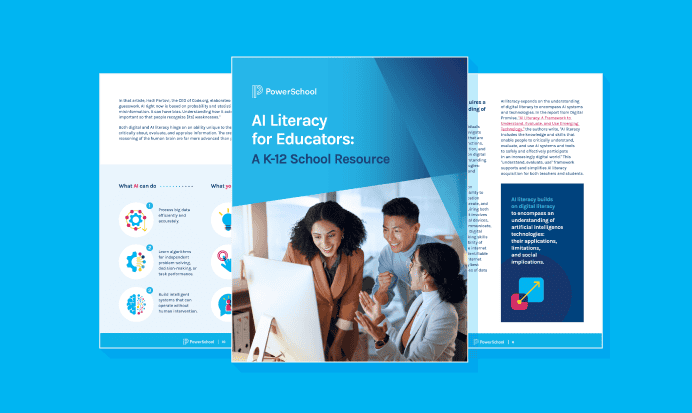
AI Literacy for Educators: A K-12 Resource
Learn how implementing an AI literacy framework can help prepare your students for effectively using AI in school and beyond.
GET YOUR COPY