AI will transform analytics in K-12 education. While this blog provides a few examples, note that I’m only scratching the surface. Greater use of AI-powered tools will create teaching and learning opportunities the education ecosystem has aspired to but not yet realized.
How AI Will Change Education and Build Data-Driven Cultures
Let’s start with controversy. Data-driven decision-making has become an overused term. I think it’s analogous to when the doctor says, “Eating your vegetables is important.” Of course it’s important. We know this! But what if there was some magical thing that would suddenly make us eat vegetables with the same mindless fervor that I eat popcorn while watching a movie?
I believe AI could be this magical thing when it comes to building a data-driven culture.
Different skillsets will be prioritized when this new culture forms. The ability to ask the right questions and conduct root-cause analyses to understand how to best support a student, teacher, or school will be rewarded. Other skills will be deprioritized, such as the ability to navigate a user interface on a software program or the ability to manipulate spreadsheets in fancy ways.
To share my perspective, I’d like to review the journey of analytics in K-12 over the past two decades.
First Phase: Data Wizards Rule the Day While the Rest of Us Look From Afar!
 Sometime in the early to mid-2000s, analysis was all about spreadsheets. Researchers prepared spreadsheets of assessment data for teams to review. Of course, none of this data was drillable to the student level. Some of this data was even printed on paper and placed in binders!
Meanwhile, “data wizards” might impress their colleagues with fancy spreadsheet machinations such as pivot tables, v-lookups, and the occasional macro. These individuals were the go-to “magicians” in the organization on all things data. This meant they had disproportionate power in setting the data culture, leaving out others who had deep knowledge of student needs, but perhaps not top-notch spreadsheet skills.
Second Phase: A Data Analytics Platform Can Offer Insights!
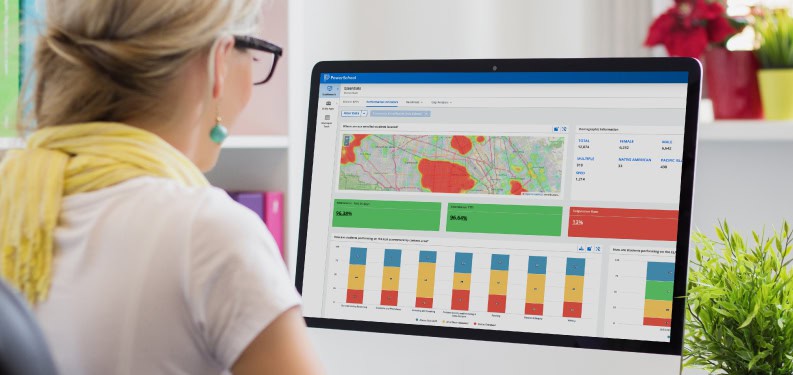 Eventually, technology came to the rescue. Analytics platforms, such as PowerSchool’s Student Analytics, were brought to the forefront. This included the ability to house a one-stop shop for all data, including assessment, attendance, behavior, social and emotional learning (SEL), enrollment, talent analytics, and more. With this platform, end users can view data in aggregate and then with one click drill to the student level. This data is transformative for education organizations. Researchers and data analysists are still needed, but their expertise can be diverted to other critical tasks rather than spending hours connecting disparate source systems for the purposes of creating spreadsheets.
The Next Frontier: Data Collection and AI for Schools
Even when data access and insights are technically there, K-12 organizations still sometimes struggle to build a data-driven culture. Data culture can often live solely within Professional Learning Communities (PLCs) or grade level meetings, when groups of educators, with laptops out, collectively review student data.
But AI has the potential to transform the use of data by making data-driven decision-making more ubiquitous due to its ease of use. AI systems enable new forms of interaction, such as the ability to “talk to your data.”
 AI has the potential to transform the use of data by making data-driven decisions more ubiquitous due to its ease of use
Rather than navigating a platform, clicking several times, and then viewing data on a dashboard, an end user may instead talk to a computer, tablet, or mobile device. “Tell me which of my incoming fourth graders were not proficient on the state assessment in ELA (English Language Arts).” Then the application displays a visual of the information.
That data can be broken down even further. Of these students, how many were chronically absent last year? This information is quickly gathered and requires no navigation of a platform. It simply requires sound inquiry and diagnostic skills. AI can then produce high-level insights from the data generated in the form of a narrative. All of this can happen during that formal meeting, but it can also happen quickly in impromptu settings.
The technology will allow educators, including those who perhaps previously didn’t have strong technological proclivities, to access information in a new way. A byproduct is that this will provide them with a greater voice within a district’s data-driven culture. It will also provide insights in the moment to enable educators to better meet the on-demand needs of students as they emerge.
But let’s not forget about other users of data, such as families. According to PowerSchool’s Education Focus Report, most families navigate between 2-6 systems to access the information they need to understand how their student is learning. Making it easier for families to engage with schools and better support their student is critical. With the assistance of AI, technology like MyPowerHub provides a single-pane-of-glass experience for parents to consolidate all school related information, (i.e. grades, attendance, field trip forms, student’s schedule, upcoming assignments and so forth). Parents can simply type questions within the application to ascertain necessary information. Clicking is minimized and navigation not needed.
PowerSchool has begun to democratize data in real ways. We have embedded AI functionality into existing education technology systems already known to end users. This minimizes learning curves. We also embed AI within secure environments that are monitored, 24 hours a day, 7 days a week to preserve data privacy and security.
Responsible AI
This brings me to the last set of critical points. AI solutions have an increasing impact on education with a potentially transformative effect. As we build novel applications that use artificial intelligence, we must be committed to solely focusing on solutions that positively impact education. To maintain a mindful and responsible approach to AI, organizations should be guided by foundational principles to ensure its proper and ethical use.
For example, one critical principle is that AI should be human-centered. The recent report by the U.S. Department of Education Office of Educational Technology, titled “Artificial Intelligence and the Future of Teaching and Learning: Insights and Recommendations,” states it nicely when it recommends that we “pursue a vision of AI where humans are in the loop. That means that people are part of the process of noticing patterns in an educational system and assigning meaning to those patterns.”
PowerSchool has developed a set of its own guiding principles on AI use, which can be found in the blog The Ethics of AI in Edtech: Ensuring Student Success in a Digital Age. Before adopting any edtech solution, every educational community should ensure it thoroughly understands how the provider will use AI. Is your data being managed in a secure and ethical manner? Are you required to surrender your data to AI instead of bringing AI to your data? Modern, responsible, and ethical AI use can help all of us be more creative, empathic, and innovative. It will also help districts build an effective data-driven culture once and for all.