

Oxford Public Schools is a small district of about 1,600 students in Oxford, Massachusetts. Kadion Phillips, a former teacher and school administrator, is now the district’s Director of Technology. He recently sat down with PowerSchool to discuss how they transitioned their special education management online during last spring’s school closures, thanks to existing workflows with interoperable, intuitive edtech solutions.
Here’s an overview of the conversation, including the features they looked for in new special education software and the benefits they’re receiving now.
Oxford’s Top Special Education Challenges
The district transitioned their student information system (SIS) from a smaller vendor to PowerSchool SIS about three years ago, looking for a system that was more robust, more reliable, and more accessible to parents as well as staff. At the same time, they made the decision to adopt PowerSchool Special Programs, due to the strong integration between both solutions.

The district’s previous special education software was clunky and cumbersome for staff. It required a separate login for users that made it difficult to access information quickly. As a result, staff often ended up printing IEPs and 504 documents and housing them in a file cabinet to avoid having to log in to the system—meaning the information quickly went out of date.
“If a staff member printed a copy at the start of the year, by the time they were looking at it in the middle of the year or towards the end, that could be very incorrect,” Phillips says. “That was a major issue where some of the accommodations that the students needed may not have been met, because we were looking at wrong information or not up-to-date information.”
In addition to the system being difficult to access, the siloed software required duplicative data-entry tasks. Because their SIS wasn’t integrated with the special education software, staff would spend time going back and forth to copy over the student data they needed.
“As you would imagine, that would sometimes lead to errors because of the manual data input,” says Phillips. “So the fidelity was just not there.”
Why They Chose PowerSchool Special Programs
The district did not have to look far for special education software that helped alleviate the challenges they were experiencing. Due to its interoperability with PowerSchool SIS, PowerSchool Special Programs was the logical choice for Oxford’s special population management and documentation.
The district had similar reasons for choosing Special Programs as it did when choosing PowerSchool SIS. Special Programs is a robust option that increases accessibility for their teachers and staff due to single sign-on (SSO) for both solutions. The integration of SIS and Special Programs also means eliminating manual data entry between the platforms—which in turn means fewer data inaccuracies.
Special Programs Success
After switching to Special Programs, Phillips says the biggest immediate benefit they received was increased accessibility. Teachers can now find IEPs easily for whole classes or specific students online and view the entire document securely.
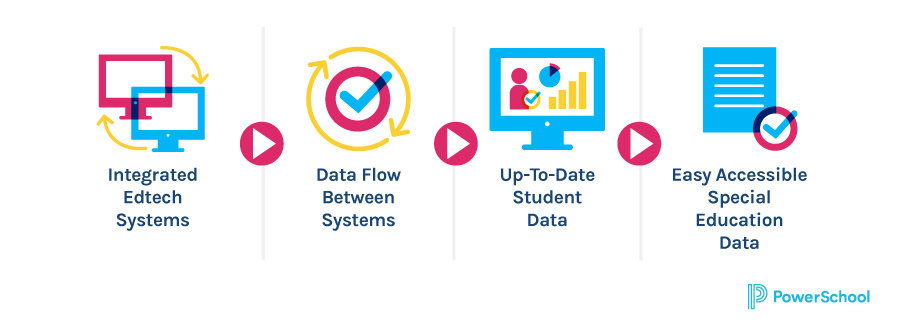
Data now flows seamlessly from their SIS, matching fields like student name, ID number, and parent contact information. On IEPs and other special education documentation, all of that information comes directly from the SIS, meaning data only has to be updated in one system, not two.
“We always have data flowing constantly between the two systems. And we set up exactly what fields we want to flow back and forth,” Phillips says.
Access to the data itself is also more easily controlled now. Phillips says teachers and special education specialists can only see or edit the documents that they are given access to, and since that access only needs to be given in one system, it again eliminates duplicate work, saving time while keeping student data secure.
“All the security is done within the backend. When a teacher comes in, they can only see or edit the portions they have access to, based on the rules that we’d set up ahead of time,” Phillips says.
And when school campuses closed last spring due to COVID-19, the district didn’t miss a beat in keeping their special education documentation up to date.
“If we’re doing what we were doing a few years ago with paper copies, I’m not really sure how we would have functioned, especially with the accommodations for students,” Phillips says. Instead, “the only difference was we were doing it from home as opposed to doing it from within the building.”
“When we made that transition, because we had already changed our systems to be completely online, everything was basically business as usual,” he continues. “The only thing that changed was the setting in which things were getting done.”
Special Education Management Made Better
With the current state of hybrid education, where not every student is learning on campus, having digital access to up-to-date special education documents and data is more important than ever. With learning happening in the classroom and at home, it’s important that teachers have the right management tools to support their special population’s students. No matter where they are.
With PowerSchool Special Programs and PowerSchool SIS, special education documents can be created and updated automatically, tying back to the SIS and ensuring easy access to accurate data for staff within their normal workflows.

Want to hear more of Oxford Public Schools’ story?
Watch the full webinar with Kadion Phillips, district Director of Technology, on demand!
Watch on Demand