

How school and district finance directors can lead strategically and help drive student success
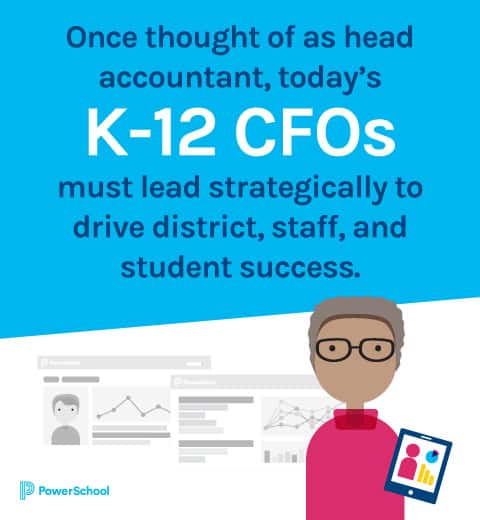 School district finance directors know that job roles change. Whether it’s because needs evolve, priorities switch, or new technologies modify processes, change is inevitable.
For K-12 CFOs, what was once a job rooted in accounting and balancing delicate budgets now requires them to sprout new skills and thrive as strategic leaders. Superintendents, school boards, and fellow department heads depend on the CFO’s financial experience and insights to impact district, staff, and student success.
In this blog, we’ll look at how (and why) the CFO’s job has changed, what they’re responsible for now, and what skills and resources they need to succeed.
Days of old: A CFO’s onetime role
Traditionally, school district chief financial officers worked in the back office on all things finance and accounting related. Some of the main tasks included:
- Paying the bills
- Managing the budget
- Balancing the books
- Preparing for financial audits
- Reining in unnecessary or extravagant spending
Today’s CFOs, however, are being tapped not only to find the money needed for a long list of expenses, but also to analyze and advise on strategic decisions that have a direct impact on educational outcomes. That means, in addition to managing all the traditional financial tasks, CFOs now must also:
- Re-evaluate whether previous financial allocations and/or priorities are still in line with current and future goals
- Analyze and advise on plans for financial investment in both capital and instructional expenses
- Use a combination of technical, communication, and leadership skills to influence school, district, and student success
In “The CFO’s Evolving Role as Chief Operating Officer,” author Michael J. Hoyle, Ph.D., says, “CFOs are no longer solely the spreadsheet gurus… An effective CFO is not only looking at past trends and making sure the books are balanced, but is also proactively focusing on the future, 10 to 20 to 30 years out.”
“The job has changed from a compliance focus, concentrating on things like budget creation and management, accounts payable, bidding, payroll, and internal and external audits,” says Dr. Richard Middleton, former district superintendent, as well as Regional Vice President of the Southwest Region of The College Board and current PowerSchool Academic Advisor. “Now, in addition to all of the financial responsibilities, CFO’s are responsible for data-driven decisions about instruction and hiring. The CFO creates and manages the accountability for cost controls and budgeting direction, focusing on student needs.”
One reason the CFO role has changed is to take some of the burden off of superintendents in key financial decision making, explains Dr. Jeffrey Felix, former K-12 superintendent and current PowerSchool Academic Advisor. “For too long, district superintendents sat alone at the top of the organization making decisions in solitary because nobody understood the myriad of positions, jobs, regulations, and laws that establish these places of learning,” he says. “Since the late 1990s, increasing rules and regulations made it impossible for the superintendent to manage the job alone, and CFOs became the partner that we see today. This change made sense since many of those new laws were unfunded mandates, and the CFO was desperately needed for the beleaguered schools to fulfill new directives with the same funding.”
Many CFOs face a changing district landscape in which there’s much more compliance in the role than ever before, says Dr. Kecia Ray, member of the International Society for Technology in Education (ISTE), former president of the ISTE Board of Directors, and Academic Advisory Board member at PowerSchool. “Many districts are moving to student-based budgeting and site-based budget management, and the oversight from central office is much higher when this is the structure. More site-based budgeting and diversification of funds used to support K-12 programs.”
Strategic financial planner
The Harvard Business Review presentation, The CFO’s Changing Role: Building the Future, highlights how the CFO’s role has expanded. Initially, the role was of steward and operator, protecting and preserving an organization’s critical assets, ensuring accurate reporting, and operating efficiently and effectively. Now, however, roles include strategist and catalyst, in which they provide financial leadership for the overall direction, and instill a “financial approach and mindset throughout the organization while creating a risk-intelligent culture.”
CA
“Look for someone with years of experience in multiple roles within the finance function, in operations, and with technology skills. It’s also increasingly important to find a CFO with strong track records in change management, both within finance and throughout the organization. You want a leader who can deal with frequent disruptions that require changes in resource allocation.”
Jeffrey Felix Former Two-Time California Superintendent of the Year
Academic Advisory Board Member at PowerSchool
“When No Child Left Behind became law, schools were ushered into an age of accountability for both student results and finance,” says Lisa Andrejko, Ed.D., a former Pennsylvania K-12 superintendent and currently the Lead Strategic Education Advisor at PowerSchool, in further explaining a CFO’s financial leadership responsibilities. “As costs have risen in education, it’s important to have leadership that can face the board and the public to ensure taxpayer funds are spent judiciously.”
Dr. Ray adds that modern CFOs have the right visibility into funding sources to make informed budgetary decisions. “There are many sources of funds coming into districts now, including public-private partnership (P3) funds and large grants. This diversity in funding requires strategic alignment to the requirements of each fund. A CFO can see the budgeting and accounting from a much higher level and can supplement and supplant concerns,” she says.
Data, data, everywhere
In today’s K-12 schools and districts, leaders can’t afford to make strategic decisions blindly. That’s why accurate data is so important. Equally key is the ability to make sense of all the student, staff, and organizational analytics that are available, especially when tying funding back to student success.
“The high level of accountability for school funds means using more data is needed to show the outcomes from the funding,” says Dr. Ray. “More and more districts are being asked to account for their spending with real data rather than subjective narratives.”
According to Dr. Lorraine Lange, a former superintendent of Roanoke County Schools, VA, and current PowerSchool Strategic Academic Advisor, analyzing data is one of the CFO’s most important responsibilities. “I think the role has changed so much because instruction is more data-driven than in the past. CFOs analyze data and help make accurate predictions and are more a part of the instructional team. They know more about instruction than in the past so they can help the superintendent and the leadership team in making major decisions,” she says.
Adds Andrejko on how CFOs can use data to justify ROI: “The measure of the effectiveness of programs, products, contractors, and more can all be measured by data.”
Strength in numbers: collaboration is essential
Chief financial officers must be collaborators who understand the intricate balance required to educate students in today’s high-stakes and high-standards—but low-budget—educational landscape. Chief financial officers should become skilled at not only analyzing and understanding long-range financial implications of various decisions, but also be able to communicate those implications to stakeholders, such as other district leaders, board members, teachers, and parents.
FL
“Build bridges, not roadblocks.”
Lisa Andrejko, ED.D. Former Superintendent
Lead Strategic Education Advisor at PowerSchool
From a superintendent’s perspective, Andrejko says the director of finance should be part of a collaborative administrative cabinet or leadership team. “Build bridges, not roadblocks,” she advises for today’s CFO. “Be informed about goals. All members of the leadership team need to have access to multiple sources of data from student success, teacher effectiveness, and finance to measure effectiveness, which drives decisions. CFOs need to understand district, state, and national student achievement and educator effectiveness goals to see how financial resources help leadership and staff meet the goals.”
A district’s strategic plan is essentially a budget plan that’s almost always connected to student outcomes. “Cross walking the programs and initiatives with the funding sources and the anticipated outcomes versus actual outcomes is a collaboration between CFO, CAO, CIO, and superintendent,” says Dr. Ray.
Technology’s role
Behind the scenes, every front-office professional needs the right tools to make sure that school and district operations run smoothly. Technology that unifies, simplifies, and secures a district’s instructional and financial ecosystem provides valuable insights from the front office to the classroom and home.
“Instructional strategies for curriculum development, class size and offerings, individual student needs plans, and technology all have costs. The CFO today should have access to the highest quality of integrated software needed to determine how effectively instructional program strategies impacted student success measures and at what costs,” says Dr. Middleton.
CFOs should look for solutions that make every dollar go the distance by giving their finance and HR teams comprehensive tools, optimizing ERP investments, and streamlining processes like registration, recruitment, payroll, compliance, and reporting.
“It’s vital we search for all tools that provide our organization with a competitive business edge. That’s what can be achieved through the use of ERP software. With the job requirements actually doubling for the CFO, it’s important to find simpler ways to manage staff, students, facilities, and inventory,” says Dr. Felix.
Documentation, management, and tracking funds is key to knowing which funds are used for which activities. K-12 ERP systems, comprised of business and finance/HR software, store that essential financial data in a single database, allowing the CFO to work with the same information for all situations. Modern systems can organize, analyze, and create data reports for all responsibilities, including student management, human resources, business intelligence, financial management, inventory, and facility management.
The bottom line
With a changing role, today’s K-12 CFOs can take pride in knowing that their financial and strategic expertise is helping support district goals and driving student success. When fully informed and engaged in the strategic decision-making process, and with the right set of finance and HR tools, finance directors can have a positive and lasting impact on the financial stability and instructional quality of a school district.

Learn More
See how Denton ISD continually updates its budgets to optimize student success.
Watch on Demand