

This year has already brought school districts a lot of surprises. Your year-end tax filing shouldn’t be another one. Getting through this annual rite of passage typically includes responding to changing filing requirements that are dictated by the tax code. And after such a turbulent year, what a relief it would be if this year were an exception! Alas, it is not. This fiscal year introduces several new changes to tax filing, and you definitely don’t want to get caught off guard.
Every year districts struggle with year-end filing to some degree. For most of us, we’re nearly a year out of practice. We may even be coaching new staff members through the process for the first time. In addition, this year most of us will be working remotely and without the benefit of connecting with a close-by co-worker for help.
Making matters more challenging, there is a clear deadline for filing, and some districts don’t discover that they’re ill-prepared until the last minute. In 2019, PowerSchool received a lot of last-minute support calls from districts struggling to reconcile payroll and 1099 data. Many struggled to understand recent filing changes. To help this year, we wanted to offer you a few examples of the current changes and some suggestions for how you might best prepare.
3 Major Reporting Changes to Year-End Tax Filing in 2020
1. 1099-NEC
One of this year’s biggest changes is the creation of the 1099-NEC form, which replaces the 1099 MISC box 7 and breaks it out into more detail. NEC, or Non-Employee Compensation, refers to someone who received more than $600 in compensation but is not a direct employee.
As the IRS reports:
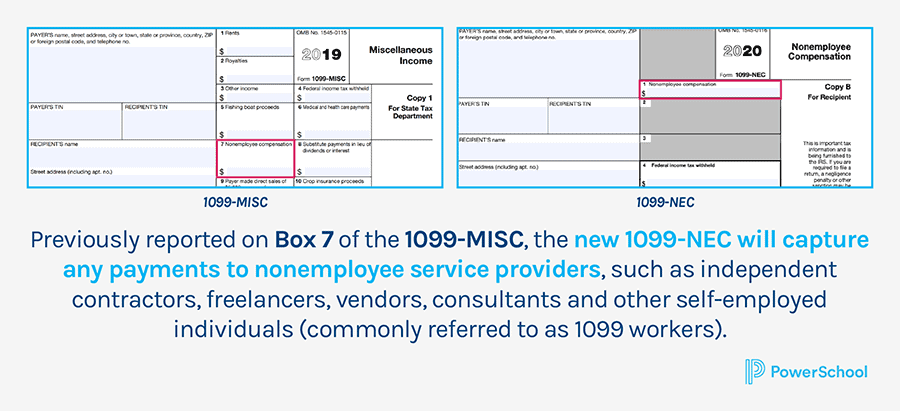
When COVID-19 struck, many districts made huge and rapid shifts to staffing. Teachers worked from home, substitutes were restricted to specific locations, and many non-employees were brought in to help. Examples of non-employees were the contractors that districts brought in to support plans and execution. For example, contractors may have been hired for special cleaning, consultants to help with safety planning, or vendors to help with Personal Protection Equipment (PPE). Districts should already track this data as reported in 1099-MISC form box 7. This set-up should remain in place.
2. FFCRA requirements
The Families First Coronavirus Response Act (FFCRA) requires employers to provide employees with paid sick leave or expanded family and medical leave for specified reasons related to COVID-19. It requires employers to provide up to 80 hours of paid leave to employees for certain COVID-19-related reasons under the Emergency Paid Sick Leave Act (PSLA) and expands the Family and Medical Leave Act (FMLA) to provide employees up to 12 weeks of emergency job-protected leave to care for a child as a result of school or childcare closings due to a public health emergency. This has resulted in additions to specific Sick Pay wages reported on W-2s.
3. ACA changes
All employers with 50 or more employees are required to submit Form 1095-C to the IRS. This form details the coverage offered to their full-time employees and their dependent children. This year, districts need to record zip codes corresponding to the months that coverage was offered. To assist with this change, we are providing Form 1095-B reporting for customers on BusinessPlus as well as eFinancePlus versions 19.4 and higher.
3 Ways to Prepare for Year-End Filing
1. Assemble your team now
Even in a normal year, while in person, it can be challenging to complete year-end filing on time. But this year, many district teams are operating remotely. Consider getting a jump on tax time by blocking out time for your team now, so they already have it on their calendars. Once assembled, make sure your team knows their roles and that they have time set aside on their calendars to begin running year-end tax reports.
If you have a number of new staff, you may even want to do a practice run using last year’s data as a starting point to get comfortable with the process and tools.
2. Set some early deadlines
With end-of-year deadlines, it’s easy to put all your focus on the final delivery at the end of January. However, it’s a good idea to set up some early milestones to make sure you don’t wait too long to implement some of the new changes. While Q4 is still going on, you can work early on your first, second, and third quarter data. We recommend making sure that quarters 1, 2, and 3 are in balance by the end of November, so you’ll be set up for success at the end of year. Use the time to reconcile your employee taxable wages, tax deductions, contributions, vendor liabilities, and expenditures. Then you can focus on Q4 once the books close.
3. Become familiar with the new 2020 changes and processes
Make sure you’re familiar with all of the changes happening this year, including FFCRA wages, 1099-NEC requirements, and FICA deferment. Check out the IRS website for guidance on the new W-2 and ACA requirements. Changes may continue to come in from federal and state governments, so make sure you stay engaged as they are shared.
PowerSchool’s Year-End Training Services
At PowerSchool we go beyond just providing technology and the training on how to use it. We leverage our decades of finance and K-12 experience to provide full-service support to help your district run more smoothly.
This year, we’ve built out a specific year-end service to assist you with tax filing in these unusual times. Built from the ground up for a remote operating environment, PowerSchool’s year-end service will give you all the tools you need to prepare your staff for the year’s end, implement all the necessary changes, and hit key deadlines.
Our year-end service includes the following elements to make you successful:
2020 Year End Guide and Details. You get a summary of all the major changes that might impact your district, and steps for its implementation. This is your resource for all things related to end-of-year filing.
Live Seminars. We hold several hour-long online seminars to review the end-of-year issues and ways you can best implement them in your school district. Seminars are also recorded, so you can refer back to them whenever you have any questions. If you can’t join one of the live sessions, you can access the recordings any time that’s convenient for you.
Live online seminars include:
- FFCRA—Families First Coronavirus Response Act
- Payroll year-end reconciliation
- Processing 1099s for 2020
- Processing W2s for 2020
- Processing ACA for 2020
Office Hours. In addition to online presentations, our Services experts will hold weekly office hours on the same key topics. You can drop in during these times to ask questions, hear what other districts are doing, or even share your own comments. Feedback from past office hours has been very positive as attendees were able to collaborate and hear from peers and experts together.
If you’re a PowerSchool customer and you’re interested in any of these service offerings, please contact sales@powerschool.com or reach out to your account manager for more information.
Learn More
To learn more about how you can prepare for end-of-year K-12 financial filing changes, watch the recording of the webinar.
Watch on Demand