

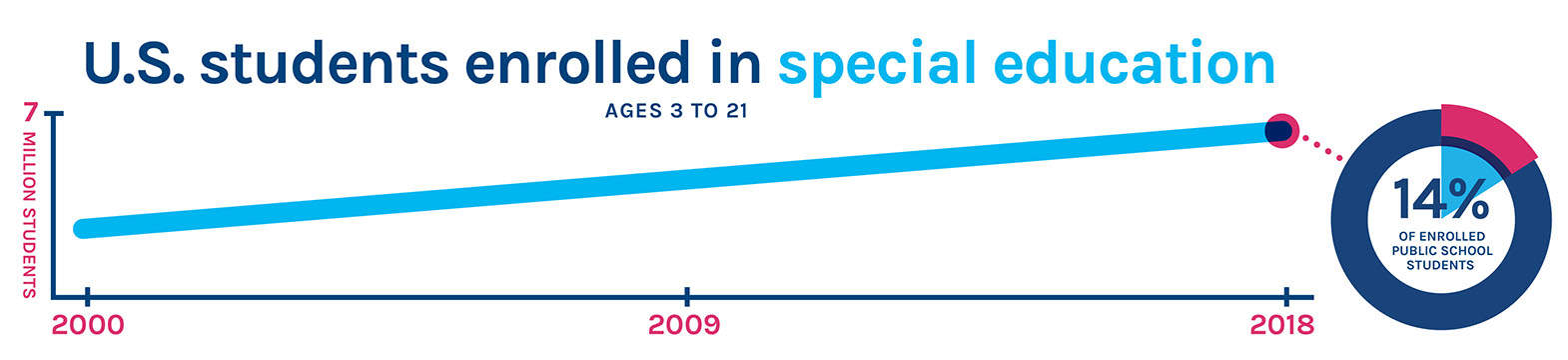
The number of U.S. students enrolled in special education from ages 3 to 21 grew for the seventh straight year in 2017-18, reaching a new all-time high of approximately 7 million. This accounts for 14% of students enrolled in public schools, up from 13% in previous years.
While the rate of students diagnosed on the autism spectrum continues to rise steadily, the largest category of special education students is that of those with specific learning disabilities. These are students with disorders in one or more basic psychological processes involved in language. They may have an imperfect ability to listen, think, speak, read, write, spell, or do math.
Whether the continuing rise is due to more careful diagnosis or an increase in childhood disabilities, the trend is clear—demand for special education services shows no signs of slowing down.
Growing demand as the teacher shortage worsens
For many schools and district, increasing demand for special education services exacerbates the already difficult challenge of a nationwide teacher shortage. For the 2017-2018 school year, 46 states reported too few special education teachers. And with universities only preparing about half the number of special education teachers needed each year, the gap between supply and demand keeps growing.
Diving into the data
Even as overall demand for special education services grows, the data shows a mix of increases and decreases in specific student needs.
The 10-year span from 2007-08 to 2017-18 saw significant changes, including:
- A 140% increase in number of special education students with autism
- 56% more students diagnosed with “other health impairments,” including physical strength and acute health problems like heart conditions, tuberculosis, leukemia, diabetes, hemophilia, and lead poisoning
- 29% more students with a developmental delay
- A 5% decrease in specific learning disabilities, although this number has risen slightly over the last two years
- A continuing decline in emotional disturbance, down 21% over 10 years
- 15% fewer students with an intellectual disability, though this number has stabilized the last three years
Data source: National Center for Education Statistics
Policy and diagnostic practices have changed over this period, and most educators agree this accounts for much of the fluctuation over the 10-year period. These statistics do not necessarily reflect changes in occurrences of disabilities.
Helping every student succeed
As more students receive special education services each year, federal funding continues to be a key component for schools to successfully deliver the learning experience these students need to achieve their best.
But schools and districts can also use technology to improve special education outcomes. Driving parental involvement can make a huge difference. Helping make teachers’ workflows more efficient lets them focus more on student growth. When it comes to funding, tech tools designed to strengthen IEP management, collaboration, and compliance can make sure your district gets the right funding when it’s needed.
Learn More
Download our eBook to discover nine special education administrative tech challenges and the keys to finding the right solution.
Get the eBook