Miriam Altman-Reyes is Vice President, Go-to-Market Strategy and Partnership for New Solutions at PowerSchool. She started her career as a high school educator in the New York City Department of Education. She subsequently launched Kinvolved (now PowerSchool Attendance Intervention), a company elevating student attendance, where she served as Chief Executive Officer and Co-Founder until its acquisition by PowerSchool in 2022.
How did the COVID-19 pandemic impact student academic outcomes?
The pandemic had more dramatic adverse effects on student academic outcomes than many of us imagined. According to the results of the latest National Assessment of Educational Progress (NAEP), we lost nearly twenty years of progress in advancements in student learning. The report stated that:
- Graduation rates dropped in 31 states
- The average NAEP math score in 4th grade dropped by five points and by eight points in 8th grade
- The average NAEP math score dropped by three points in both 4th and 8th grades
According to the Education Recovery Scorecard, a recent study of the NAEP results:
- The median school district lost more than 50% of a school year in math and 25% of a year of reading
- In our highest-poverty districts, students lost 65% of a year of math and more than 30% of a year in reading
States and school systems are grappling with these results. They are seeking solutions to implement in real-time to reverse these detrimental gaps, which, if not addressed, could negatively impact an entire generation.

What is personalized learning?
EdWeek broadly defines personalized learning as “customizing the learning experience for each student according to his or her unique skills, abilities, preferences, background, and experiences.”
For decades, many educators, including myself, have gone to great lengths to create complex, differentiated lessons. These lessons would include materials designed to meet students at various stages of their learning journey in the same classroom. However, doing this manually is extremely time-consuming and labor-intensive. Thus, the default solution to classroom teaching has often been the traditional “broadcast” classroom, whereby students passively listen to and participate in one-size-fits-all lessons.
The good news is that research-backed interventions, such as high-dosage tutoring and innovative technology platforms, now exist. These solutions help educators achieve the monumental task of providing supplemental, self-paced learning to each student more manageably and with shorter prep time.
How can personalized learning address unfinished learning?
Personalized learning allows states and school districts to reimagine supplemental education within the classroom, after school, and over the summer. It offers a feasible, practical solution with measurable ROI to compensate for lost educational time.
The government provided school districts and state agencies $123 billion in ESSER 3 funds, with 20% earmarked for solutions to learning loss. This learning recovery calculator can help estimate how much investment districts plan to make based on their enrollment and the amount of learning lost.
The benefits of personalized learning will extend beyond this period of educational recovery, too. Here’s why:
- With individualized content and support to meet their unique needs, students are more engaged in their learning than in the traditional educational setting.
- Even in “normal” times, students at disparate skill levels share the same classroom. By differentiating, educators can reach every single student in the class.
- Personalized learning does not just aid with recovery and remediation, but it can also help educators meet the needs of students seeking extension opportunities to further their learning.
- Research shows that educators spend seven hours per week searching for standards-aligned content. Yet, technology solutions now exist to streamline this process, enabling educators to reallocate their time from searching for and creating personalized content to providing higher-level individual supports.
The pandemic wrought major setbacks on our school systems, especially for many of our most vulnerable learners. We are in a moment when states and school systems have the opportunity and supporting funding to transform their approaches and personalize learning for their students.
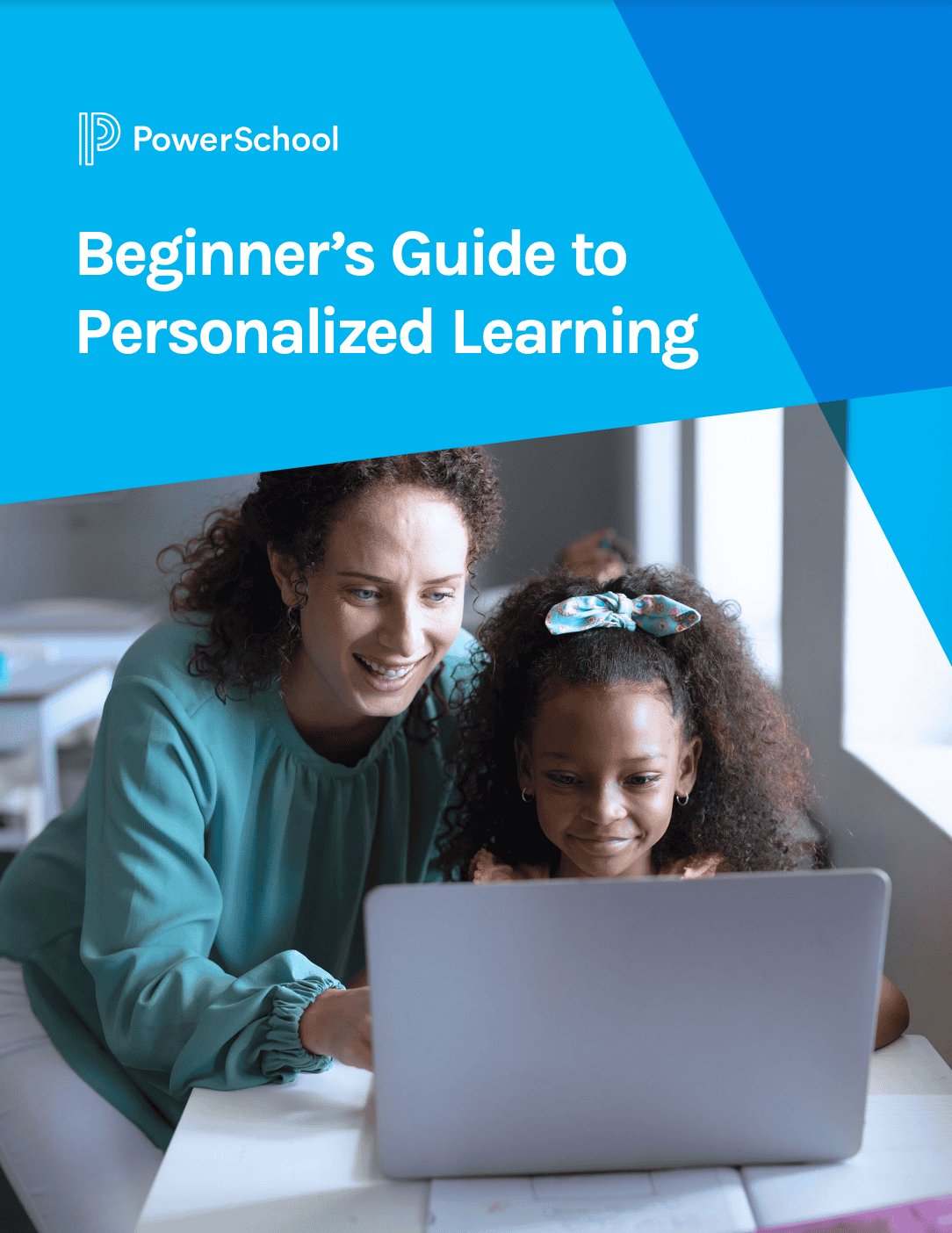
Beginner’s Guide to Personalized Learning
Learn how to shift from a one-size-fits-all instructional approach to authentic student-focused learning.
Get Your Copy