

Imagine needing to put a screw in the wall to hang a photo. When you reach for your toolbox, do you choose a screwdriver or a hammer? While you may eventually accomplish your task with a hammer, your work would be much less messy and far more efficient and reliable if you select the right tool—the screwdriver. The same is true if you’re trying to disrupt absenteeism and improve attendance with a communication solution rather than an attendance intervention solution.
Attendance intervention solutions and communication solutions are two different kinds of tools with two distinct uses. While it’s true that family engagement—fostered through frequent communication between families and schools—improves student attendance, it’s not enough to rely on a communication tool to address attendance concerns. Chronic absenteeism was an issue in schools even before the pandemic, when schools fostered family engagement through a communication solution. Schools need a different tool to address absenteeism.

To put a screw in the wall, you use a screwdriver. To communicate with families, you use a communication solution. And to improve attendance and reduce chronic absenteeism, you need more than a communication tool—you need an attendance intervention solution.
Why do schools and districts need an Attendance Intervention solution?
The effects of chronic absenteeism on student outcomes are well documented. They include delayed or atypical social and emotional development, increased inequities across vulnerable populations, an increased risk of adverse physical and mental health, and an increased risk of dropping out of school, among others.
Research also makes clear that meaningful family engagement has a positive impact not only on academic achievement but also on mental and behavioral health. Engagement can take many forms but at its core is the fundamental principle that regular, ongoing contact in the form of two-way conversations between schools and families builds a relationship where each relies on the other as a valuable resource.
Family involvement is certainly an essential piece of reducing student absenteeism. But relying on a communication solution to address an urgent problem is like choosing a hammer when you need a screwdriver.
What’s the difference between attendance tools and communication tools?
A communication tool strengthens and simplifies communications and notifications between school and families while increasing family engagement. Depending on their varying capabilities, these tools enable teachers and administrators to send text messages, emails, and phone calls so that families can receive critical updates and information such as classroom events, policy changes, and more.
An attendance tool also facilitates communications between school and families, but this communication is much more customizable for personalized interventions depending on a student’s behavior and attendance patterns. Attendance tools can let families know about daily and period attendance, send automatic absence notifications, and collect student attendance data for analysis and intervention.
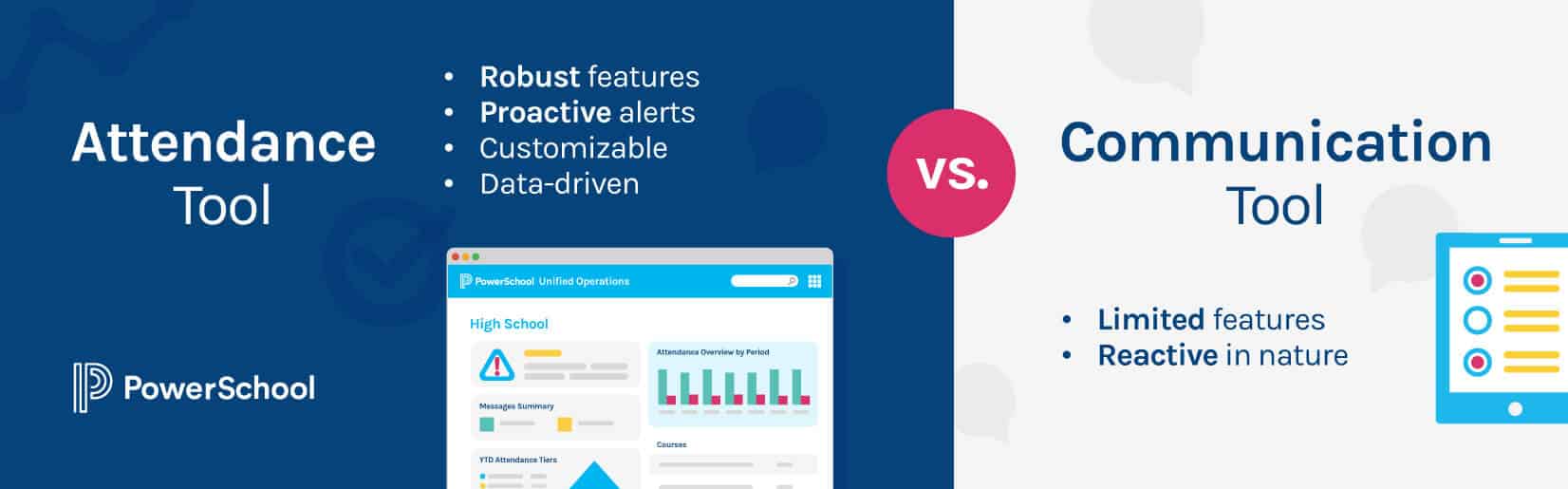
5 Key Differences between School Attendance and Communication Tools
Features of the Tools
The typical features of an attendance intervention tool include:
- Attendance tracking
- Recording reasons for absenteeism
- Customizable and personalized interventions
- Automated alerts
- Support for changing attendance behavior
- Proactive attendance analytics to reveal absenteeism patterns
The typical features of a communication tool include:
- Texting, file sharing, and video conferencing
- Task management
- Notifications about attendance after the behavior has happened.
Users and Audiences for these Tools
- Attendance intervention tools are typically used by student services or attendance support team members who are working specifically to improve attendance or prevent chronic absenteeism by engaging and providing actionable attendance data to schools and families. Families can receive real-time notifications to address absenteeism with their student in the moment.
- Communication tools are typically used by administrators who are responsible for communicating with families, regardless of whether attendance is a primary concern. Communication times may be pre-determined, delaying families from accessing information they might need sooner.
Purpose of these tools:
- Attendance intervention tools are designed to track and boost attendance.
- Communication tools are designed to promote collaboration and communication between families and schools.
Timeframe for these tools:
- Attendance intervention tools can deliver notifications in live time. They track attendance over designated periods (a month, a semester) and deliver appropriate and timely interventions based on this data.
- Communication tools are used on an ongoing basis, often at a cadence pre-determined by the administration.
Security of these tools:
- Attendance intervention tools gather sensitive information about students that requires robust security and meets student privacy laws.
- Communication tools may have less robust security as they primarily store contact information, messages, and shared files.
*These notifications tend to be reactive and punitive in nature, in contrast to an approach that identifies students with worrisome absenteeism patterns and allows schools to intervene and provide support before a student becomes chronically absent.

How Jefferson County cut chronic absenteeism by 5%
See HowChose the right tool for your attendance improvement plans
While communication tools are useful for other purposes, they fall short of meeting the needs of targeted, intentional efforts at reducing absenteeism, implementing support, and notifying families of missed classes. Many attendance tools have communication functionality, creating the most robust tool for staff to meet the needs of their students. To solve an attendance problem, start by reaching for the right tool.