In 2021, two of every three teenagers followed social media influencers—for everything from beauty and fitness tips to music and gaming trends. While there are both good and bad aspects of these influencers’ effect on youth, it’s clear that there is indeed an impact: 70% of teens say they trust influencers more than traditional celebrities.
There are, however, other influencers who impact students’ lives, and they’re much closer to home. Parents, guardians, and other family members play a pivotal role in influencing the success of a student’s education.

Research shows that when parents and/or a network of supportive adults are involved in their student’s education, the student thrives in multiple ways—including better grades and test scores and even reduced absenteeism by 40%. Conversely, a difficult home life can also have an impact on a student’s performance. For example, when there’s a divorce in the home, students are more likely to be held back and fail to earn a college degree.
To help nourish that vital positive adult engagement (and influence student success), educators can help by improving communication between the school and home.
How Families Can Serve as Effective Influencers
Family engagement is the most effective way schools can impact enrollment and attendance to combat chronic absenteeism. At the same time, attendance is one of the most critical factors in student success, making it that much more important to ensure students are consistently in class.
When a student skips class, it’s important for the school to alert the family through timely, dependable communication. As an example, a Brooklyn high school teacher worked with one student’s grandmother to add more family members to her contact list.
“If that student is out, it’s clear she’s cutting class,” the teacher says. “Now, any available family member can help deal with it.”
The expanded circle brought drastic results: “I sent two text messages home, and suddenly the student was getting to school before the first-period bell!” says the teacher.
When families are engaged, students take more responsibility for their attendance and learning and hold themselves accountable for their actions in and outside school. When families talk to their students about assignments and grades, their day-to-day experiences in school, and their hobbies and interests, it becomes easier to discuss academic progress, future plans, difficulties, and social and emotional wellbeing.

How to Better Connect with Families
Modern communication tools are essential to improving engagement with families. Engaging in two-way conversations with a communication tool creates a partnership between school and home, allowing families to feel included and empowered to provide information about what support they may need to improve student outcomes.
Tools can also offer two-way communication and language translation via text messages, emails, and auto-call notification to families, who can respond directly to school messages from their mobile phones or email accounts. Advanced tools may offer multimedia messaging abilities where teachers can send images of assignments, events, and classroom updates—or PDF files of things like policy updates or homework assignments.
The right tool can allow you to automate notifications based on your attendance tiers. You can drive engagement and set communication expectations by starting the school year with more frequent attendance notifications.
Educators should try to implement multiple forms of communication based on a family’s needs and preferences. In an example of how this can impact student performance, a parent was receiving automated phone calls of her student missing classes. But because the parent was deaf, she wasn’t receiving the calls. She eventually switched her preferred form of communication to text messaging and added another contact to the student’s account.
Just by adding another family member, the student’s attendance went from 38% to 68% in four weeks.
When looking for a communication tool to add to your edtech toolbox, look for one that integrates with your SIS and provides two-way translated communications.
“With language translation and text message delivery, more families are receiving—and reading—the attendance letters, and they’re taking action. We are overwhelmed with the level of family engagement, in a good way. Families have responded to the text-based letter in nearly real-time,” says Scott Randolph, Director of School Attendance, Ector County Independent School District, Odessa, Texas.
Recognize a Wide Diversity of Family Structures
Learning about each student’s home life can ensure you know who to communicate with and in what language.
In 2019, over 12 million students spoke a language other than English at home. And research shows that fewer than one-fifth of families represent the nuclear family model of two married parents raising two children. In fact, this family structure has not been the norm since 1965. Most children in the U.S. are raised in single-adult, multi-generational, and extended households. Approximately 35% of children have lived with extended family (relatives other than a parent or sibling) before age 18.
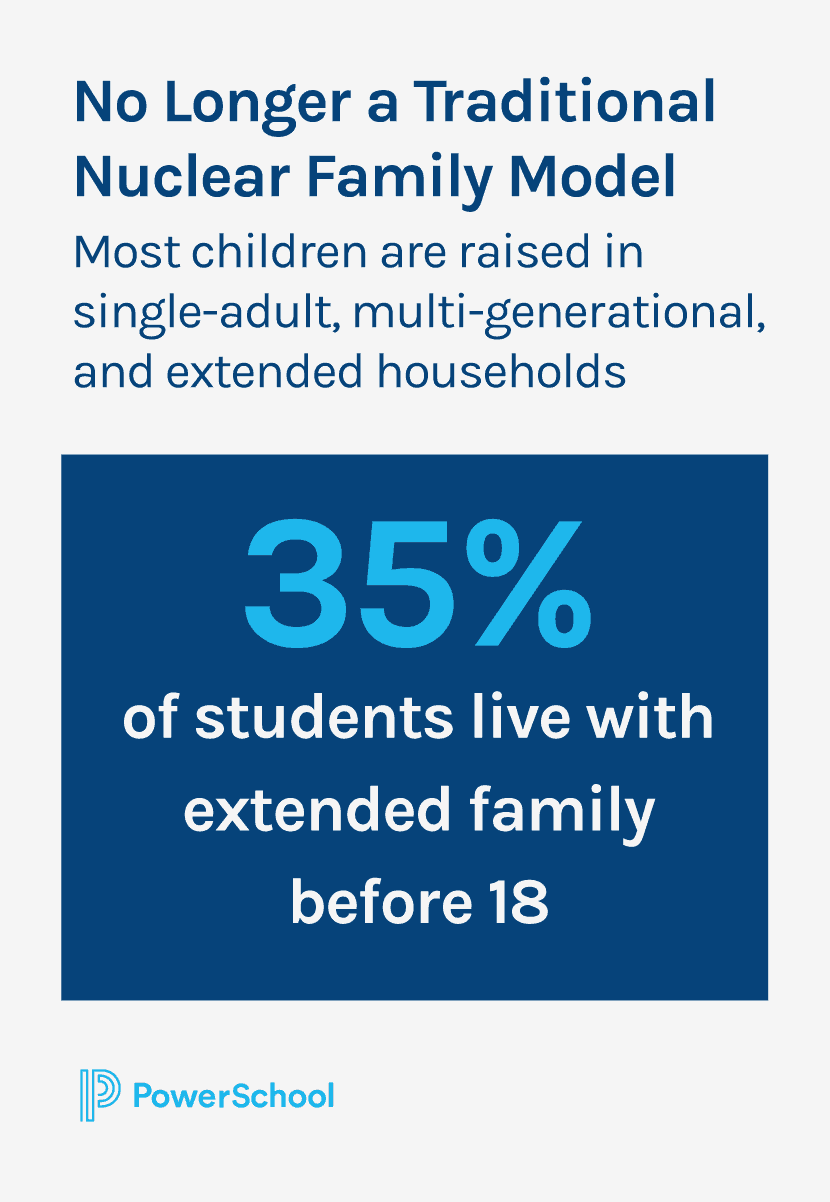
Once educators incorporate this wide range and diversity of family experiences in the classroom and learning, they increase family and student engagement.
How to Make a Family Communication Tool as Effective as Possible
When engaging families with a communication tool, there are some best practices for implementation:
- Get accurate and up-to-date contact information for family members
- As you get to know your students, ask where they spend their evenings and mornings so you learn which family members are closest when students are doing homework assignments or waking up
- Add as many contacts as you need per student, then customize which contacts receive which messages in which format
Communicating with families, regardless of their chosen language, helps strengthen the bonds between educators and families, raises awareness of attendance issues before they become unmanageable, and improves performance.
Equitable two-way communication is the foundation of any family-school partnership plan, which can in turn strengthen a family’s engagement and influence on the student. With the right tools, teachers can connect and build relationships with families throughout the school year, while also reducing the burden of outreach on busy staff.
Guide to Family-School Partnerships
Learn how to make families a partner in their student’s academic achievement.
Get Your Copy