

A guide to unifying student information to make sure accommodations don’t fall by the wayside.

IEPs are a critical part of the classroom experience. With the rise of personalized learning, it’s generally understood that not all students learn the same way. Students with individual needs require different types of accommodations to make sure they’re set up for success, often with legal implications. PowerSchool aims to simplify the IEP process, giving teachers back time by helping them stay informed and prepared to provide the best education experience for their students.
Track Student Accommodations
While IEPs are crucial for helping teachers provide the most appropriate instruction to students with special needs, too often they’re difficult to locate, update, and implement. Paper copies are rarely current and can lead to privacy issues, meaning they get locked away in office cabinets that are tough—and time consuming—to access. Digital copies typically aren’t updated either and can be completely siloed from all other student information. Hunting down the most current IEP information, and making sure lessons are prepped accordingly, can be a big time drain. Only PowerSchool makes personalized instruction based on current IEPs simple and streamlined.
PowerSchool alerts teachers and students about IEPs to make sure important information doesn’t get lost in the shuffle. With PowerSchool Special Programs, teachers have one-click access to read-only or editable IEPs and administrators can track school or district-wide compliance reporting. There’s also real-time, two-way integration with PowerSchool SIS, ensuring IEPs are always based on the most up-to-date information about a student.
Teach to Specific Needs
PowerSchool helps teachers save time when managing IEPs. Instead of manually updating or waiting for the next information sync, PowerSchool gives teachers the most current information available right away. With less of their day spent shuffling papers, teachers have more time to actually implement accommodations. Having a singular location for student information and corresponding IEPs increases their effectiveness, as teachers are able to take a more comprehensive look at every student’s individual needs.
Having IEPs perpetually updated and easy to access means teachers have more flexibility in creating lessons and projects that fit with their students’ needs. Instead of creating a whole lesson plan and having to change it at the last minute based on new IEP information, teachers can rest assured that they are working with the most current information, eradicating time wasted by redoing plans. It also means administrators aren’t bogged down by combing through IEPs to make sure everyone is on the same page and providing consistent instruction.
Unify Student Information
IEPs go beyond personalized learning. Not knowing a student has an IEP can lead to legal issues, not only for teachers but also for the school or district. Most importantly, if educators can’t see the full scope of necessary accommodations, it can disadvantage students in the classroom. By combining general student information, personalized learning preferences, and IEP accommodation information in one integrated solution, teachers and administrators are empowered to run stronger lesson plans that make sure everyone’s needs are accounted for.
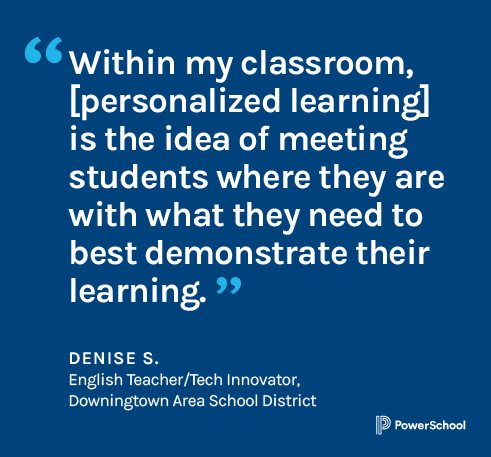
PowerSchool gives teachers the tools to understand students’ needs quickly, fostering better communication and deeper relationships in the classroom, and promoting mastery as a common goal for everyone. “Within my classroom, [personalized learning] is the idea of meeting students where they are with what they need to best demonstrate their learning,” says English teacher Denise S. With simple, secure technology for a growing abundance of personal student information, teachers can get back to face-to-face classroom time and make the most of every minute of their day.
Learn More
For more information on making IEP and other special education processes more efficient, download our whitepaper, Solutions to 9 Special Education Tech Challenges.