

Written by
Melva V. Cárdenas
• Strategic Education Advisor
Student success depends on having the right teacher in every classroom. But high turnover and a nationwide teacher shortage can make it nearly impossible to meet this goal. That’s why focusing on teacher retention is key.
Keep reading to find out how your K-12 district can reduce turnover by supporting teachers and fostering a culture of growth.
Why is teacher turnover so high?
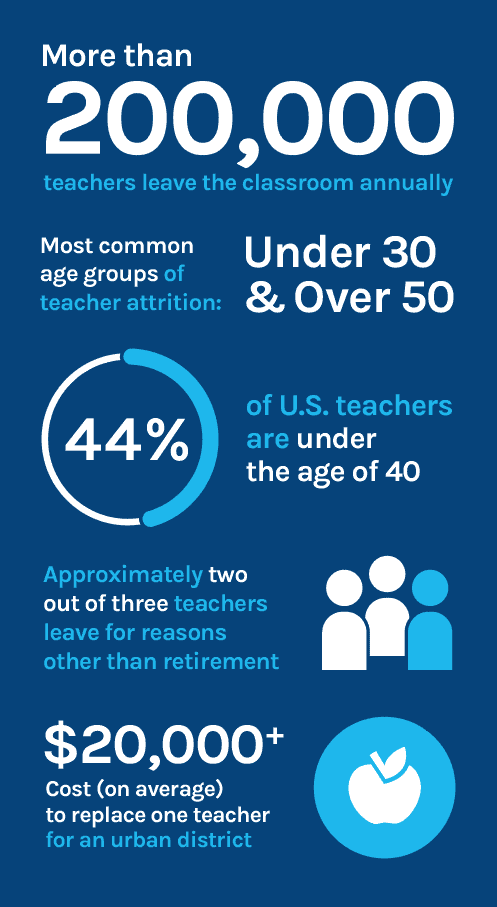 To address teacher retention, we need to first understand why teachers quit their jobs or the profession altogether. According to the Learning Policy Institute, more than 200,000 teachers leave the classroom annually. The most common age groups of teacher attrition are those under 30 and over 50. The National Center for Education Statistics (2018) found that 44% of U.S. teachers are under the age of 40. Approximately two out of three teachers leave for reasons other than retirement.
Some common reasons teachers cite for leaving include:
- Working conditions
- Lack of preparation
- School culture
- School leadership
- Compensation
- Personal reasons (parenting, medical, relocations, etc.)
For an urban district, the cost to replace one teacher could exceed $20,000 including costs associated with separation, recruitment, and training of a replacement (Learning Policy Institute 2017). Knowing there are significant financial and student achievement implications, focusing on retention is critical.
Recruit and hire to boost student success
As you set out to recruit and hire new teachers, keep in mind that the goal goes beyond simply bringing teachers on board; the goal is always to improve student learning. With that in mind, consider more than simply vetting qualifications and conducting interviews.
Research-based hiring assessments can predict a teacher’s ability to increase student achievement. By accounting for teaching skills, cognitive abilities, and attitudinal factors, the research and predictive modeling technology behind PowerSchool Candidate Assessment enables districts to hire teachers likely to boost student success.
Once a new teacher is hired, retention begins immediately with a well-structured onboarding program that goes beyond basic new hire orientation and paperwork. According to the Society of Human Resource Management (SHRM), an effective onboarding program helps new hires to acclimate to social and performance aspects of their job, so they will feel prepared for their new roles as quickly and efficiently as possible.
Districts must set up new hires for success. Being successful and confident about their job will help in the retention process.
K-12 teacher retention best practices
While there’s no quick fix, following these best practices to develop programs, policies, and procedures can help to improve teacher retention:
Implement a strong mentoring and induction program
The New Teacher Project reports that first-year teachers typically begin with great anticipation but can quickly slip into survival mode and disillusionment without support. A comprehensive mentoring and induction program provides essential support and guidance.
According to a research brief by the Northwest Comprehensive Center, “Studies show that comprehensive induction programs cut attrition rates in half and, even more importantly, help to develop novice teachers into high-quality professionals who really impact student achievement.”
Mentors should be experienced educators with a history of improving student performance, and they should receive training focused on their mentoring role. Ideally, mentors and their mentees should teach at the same grade level and/or in the same content area, and they should be afforded common planning time.
Encourage principals to establish an atmosphere of collegial support
The right principal can make a huge impact on classroom success. Instructional leadership is important, but principals must also develop a culture of collegial support. Involving teachers in decision-making processes regarding instruction is one way to accomplish this. Promoting a positive school culture is also important. Given opportunities to collaborate and provide input, teachers become part of a goal-oriented school community.
Prioritize time for collaborative planning. This helps teachers establish professional relationships and build trust. This time can be used to plan instruction, share successes, and seek support. Collaboration and time devoted to planning and professional growth will lead to improved instruction and student performance, and it contributes to teacher retention.
Ensure supervisors provide feedback, support, and coaching with a focus on student learning
One of the most common reasons that teachers choose to leave a campus, district, or the profession is lack of administrative support. Keep communication open and clear with ongoing coaching conversations between teachers, administrators, and instructional leadership.
Simply conducting a walk-through or formal observation and leaving a checklist for the teacher to review is not enough to improve teaching and student learning. Effective coaching requires collaboration and reflection.
Teachers need opportunities to share their thoughts, and supervisors must provide specific feedback and recommendations for improvement and professional learning opportunities. Feedback should be detailed, evidence-based, and timely. Use follow-up classroom visits to monitor the implementation of instructional changes and professional growth.
Provide opportunities for targeted, personalized professional learning
Targeted, personalized professional learning provides choices and flexibility in how, what, when, and where the learning takes place. Supervisors and teachers should work together to identify content and activities that will provide the most benefit.
Professional learning no longer means attendance at “one size fits all” workshops. Professional learning communities (PLCs), coaching and reflective practice, virtual or self-directed methods, and observation/modeling are a few effective practices now taking place. Tailored content combined with opportunities to practice new skills will have an effective impact in the classroom. PowerSchool Professional Learning allows districts to implement a personalized development program that’s easy to use and highly effective.
Time and resources should be provided to plan for and participate in differentiated professional learning. Use of teacher and student data to shape development plans will positively impact student learning outcomes. Analysis of such data can also help to identify campus and district needs.
Ensure that evaluation systems differentiate between effective and less effective teachers
Implementing a well-designed teacher evaluation system is essential to improving teacher effectiveness and student learning. Evaluations should be based on a common set of standards geared toward student achievement and used to track teacher development. PowerSchool Perform provides data-driven evaluations and helps leadership provide teachers with clear, consistent feedback.
A system that identifies effective teachers enables them to be recognized and rewarded. It also encourages them to build on their strengths and share their successful strategies with others.
Similarly, the ability to identify struggling teachers allows leadership to support them with personalized professional development recommendations. Once the areas of strength or need have been identified, stronger teachers can be paired with teachers who have opportunities to grow for collaboration and peer coaching. Standout teachers should be encouraged to share their expertise at the campus and district level by modeling instructional strategies and presenting to colleagues in cohort groups, PLCs, or workshops.
Student success depends on teacher retention
In the end, districts must recognize the causes of teacher turnover and implement retention strategies to prevent student learning from being adversely affected. The right teachers are too valuable to lose. By reducing costs associated with teacher turnover, we can reallocate resources to improve teacher effectiveness.
About Melva V. Cárdenas
 A 33-year veteran K-12 educator and HR leader, Melva served as director of educator certification at the Texas Education Agency (TEA) and executive director of the Texas Association of School Personnel Administrators. She holds Texas educator certificates in grades 1-8 with Bilingual and English as a Second Language endorsement, and she is a certified T-Tess appraiser and trainer.