Written by
Jean-Claude Brizard
, President & CEO, Digital Promise
Data-driven decision-making is not a new theme in education, having been referenced for nearly two decades in schools and districts across the U.S. What has changed is the sheer power of modern data systems, which provides an abundance of information about our students far beyond what we could garner through the one-dimensional, performance-based assessments of the past. It is this information that can help us better understand the full educational journey each child will take—at home, during school, and in their communities.
Yet having access to this wealth of data about our students is not enough. We must learn to interpret the information. We should compare it to historical markers. We need to aggregate the analysis into meaningful and actionable outcomes.
While the data alone can’t shift the structure of instruction or institutional operations, when paired with educators and administrators in organizations with strong data cultures, the use of data can be a powerful tool for addressing the needs of students across the learning spectrum.
It’s How We Use the Data That Counts
During the 2020-2021 school year, it became very clear that our students aren’t served by the one-size-fits-all approach to learning, especially when learning in a digital environment. As Todd Rose, a former Harvard professor, explains in “The End of Average,” each learner varies across many dimensions: executive function, emotional regulation, primary language, mental health, and others. He concluded that no one is average across every dimension and that these dimensions impact how we best learn.
To summarize: Education involves varied aspects of human development. This may sound complex, but at its heart, this means that every student brings unique life experiences with them to school (e.g., relationships, experiences, strengths, challenges).
And this is where today’s ability to collect and analyze such a significant amount of data on our students holds the promise for education. By painting a complete picture of each student, one that gives educators and administrators the ability to see each one as an individual, we have the potential to truly personalize learning and, in the process, build a more equitable educational system.
Menlo Park, CA
By painting a complete picture of each student, one that gives educators and administrators the ability to see each one as an individual, we have the potential to truly personalize learning and, in the process, build a more equitable educational system.
Jean-Claude Brizard President & CEO
Digital Promise
Menlo Park, CA

Personalized learning, at its core, is an instructional program that is informed by a wide breadth of data paired with a community of educators who are eager to leverage that information to meet the needs of each student.
Jean-Claude Brizard President & CEO
Digital Promise
Personalized learning does not mean relying solely on digital software programs, regardless of how carefully those resources have been curated. Nor does it mean that students are exclusively learning in a self-paced, individualized manner. Personalized learning, at its core, is an instructional program that is informed by a wide breadth of data paired with a community of educators who are eager to leverage that information to meet the needs of each student. Personalized learning starts with an inclusive, open-minded approach to listening to what the data tells us about each student.
About the Author
Jean-Claude Brizard is President and CEO of Digital Promise, a global, nonpartisan nonprofit organization, focused on accelerating innovation in education. He is the former Senior Advisor and Deputy Director in U.S. Programs at the Bill and Melinda Gates Foundation, where he focused on PK-16 education across five communities in four states. He is also the former Chief Executive of Chicago Public Schools. Prior to his appointment in Chicago, he was Superintendent of Schools for the Rochester City School District in New York. Under Mr. Brizard’s leadership, both the Chicago Public Schools and the Rochester City School District saw substantial improvements in student performance. Mr. Brizard is a Fellow of the Broad Center, a Fellow of the Pahara-Aspen Institute, and a member of the Aspen Institute Global Leadership Network.
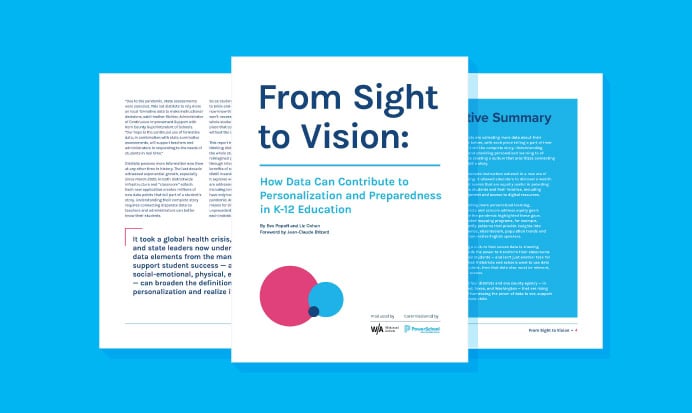
Read the Complete Report
This report investigates how forward-thinking districts and states have leveraged data to see the whole student, and by doing so, have reimagined personalized learning.
Get Your Copy