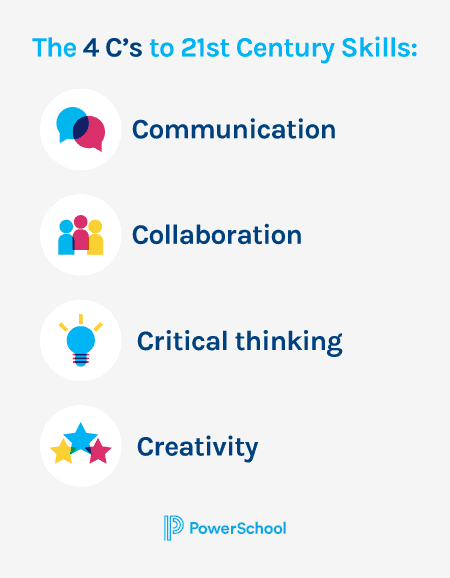
When the National Education Association (NEA) established the Partnership for 21st Century Skills (P21) in 2002, they worked to develop the “Framework for 21st Century Learning” that highlighted 18 skills as essential themes for learning in the 21st century. However, it quickly became evident that those skills didn’t provide enough focus, so in 2004 the four C’s to 21st-century skills were born. These including:
- Communication
- Collaboration
- Critical thinking
- Creativity1
But a lot has changed over the last 20 years. Just think about student access to electronic devices alone. The ubiquity of smartphones, tablets, and laptops/netbooks has driven the discussion about one-to-one computing programs across our K-12 institutions.
While the four C’s haven’t changed since 2004, the meaning and importance have evolved to reflect the dynamic education landscape. During the COVID-19 pandemic, educators, students, and families alike accomplished more via technology than many of us thought possible—none of which was possible when the Framework for 21st Century Learning or the Four C’s were initially developed.
In this blog post, we dive into how each “C” has evolved with digital learning and introduce our own C that we believe will strengthen the original four in a way that will push this framework into the future.
1. Critical Thinking
Critical thinking is synonymous with thinking well. It encompasses solving puzzles, problem-solving skills, and a healthy dose of skepticism on the part of the learner.2 Working to ensure every K-12 student has the opportunity to develop this invaluable skill is a direct investment into their future. It is vital to introduce exercises and assessments to develop this skill in K-12 for college, career, and life readiness.
One of the most significant changes in 21st century education is our dependence on devices in and out of the classroom. The iPhone was introduced in 2007 and the iPad in 2010, and while the releases were just over 10 years ago, most would find it hard to remember life without them, especially in the K-12 classroom.
In a digital classroom, access to the internet means access to infinite resources and contrasting perspectives. Understanding these resources, determining their credibility and reliability, and applying them to homework, projects, or assignments helps to build essential real-world skills. Critical thinking and problem-solving skills seep across several subjects to impact a student’s ability to concentrate, process, and analyze, whether sounding out words to write a complete sentence or interpreting the same piece of music.
2. Communication
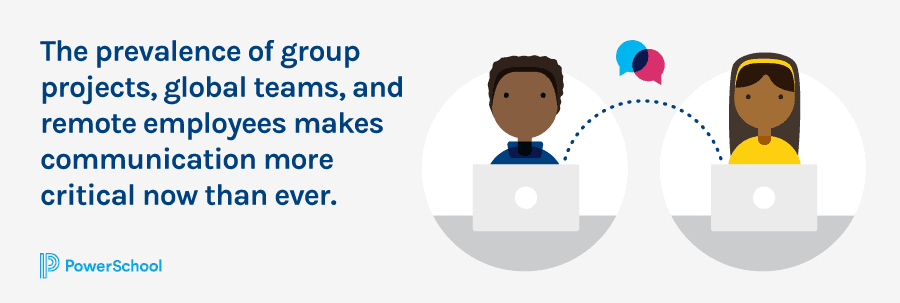
Communication is arguably one of the most essential skills for any student. Today’s prevalence of group projects, global teams, and remote employees makes communication more critical now than at the beginning of the 21st century.
For the K-12 classroom, there have been many remedies for closing the communication gap among administrators, teachers, parents, and students. Often, the most successful solution is the implementation of a learning management system (LMS).
An LMS is a comprehensive teaching and learning platform connecting students, teachers, parents, and administrators. Your LMS is a one-stop shop for even more C’s: content creation
and curation, collaboration, and communication. It’s a place where every person dedicated to learning can:
- Assess a student’s progress on learning objectives and identify students who are falling behind in specific areas (This is especially important as you return from classroom shutdowns as you may need to identify opportunities to accelerate learning gains.)
- Create space for students to collaborate (internally within groups or externally with content experts) in real time via technology
- Access apps for assisted learning (For example, a student could playback their upcoming speech to the class and hear potential mistakes.)
- Send in-system messages, such as a student’s missing homework, a positive note home, or encourage student-to-student communication
Communication can be hard to differentiate from the other C’s, but it comes down to concisely articulating a thought or idea. When you use your LMS to model and encourage communication, great things happen in the classroom. Students learn valuable lessons that can translate to professional situations they may encounter post-graduation.
3. Collaboration
Collaboration is closely related to communication. Group projects and global teams are most successful with effective communication and collaboration skills. In K-12 education, this means integrating technology into the classroom to allow voices and ideas from all over the world (especially from students) to collaborate and help teach. Send the message that collaboration is an expectation, not an extra.
In addition to setting the example and building a culture that values and supports collaboration among students, it’s crucial to provide plenty of opportunity for implementation. The key is in the planning. For example, the Center for Teaching Innovation at Cornell University recommends the following:
- Establish ground rules and vet out assessment processes before beginning
- Break down group work into stages and plan adequately for each part
- Use team-building exercises, self-reflection strategies, and consider the use of written contracts to help everyone work efficiently and understand their responsibilities to others and themselves
- Incorporate both peer and self-assessment into the process3
Done right, collaboration is much more than “doing group work.” As we emerge from an isolating time in our history, establishing an authentic, collaborative classroom culture will yield significant benefits for our students.
Most schools start by asking technology-savvy teachers to train others, but sometimes this is neither realistic nor effective. With professional development programs, coaches and teachers can collaborate to create models for better and more effective use of technology in the classroom. Collaborating and communicating this way throughout a school, or even district, can level any discrepancies and strengthen organizational culture as a whole.
4. Creativity
Creativity means thinking outside the box, but creativity also enables students to develop the ability to innovate. Innovation in the classroom involves open-ended questions, flexible learning environments, and the design process to create new solutions to seemingly difficult problems.4
Creativity and innovation are more prevalent than ever in the 21st century. Many Kauffman indicators of entrepreneurship, including the rate of new entrepreneurs, show increases in creative and innovative business pursuits.
Giving students access to innovative technologies, and incorporating them into the curriculum, is one of the most effective support systems a school can offer. This includes making the right choice in a learning management system to enhance the communication and collaboration between students, teachers, and parents.
Bringing Everything Together with Connections
The fifth and final “C” combines all “Four C’s” for successful 21st-century education: Connections.
The age of learning being partitioned into silos is over. Ours is an age of connection and integrated knowledge. Students must go beyond rote memorization to the active creation of new content and learning products.
The good news is that the path has been made more apparent by the preceding four C’s. Critical thinking blends with creativity and innovation, and communication blends with collaboration.
Student Success Resource Kit
We’ve compiled resources to help your school or district address unfinished learning, deliver personalized instruction, and better prepare students for future success.
Get Resource Kit