One of the unseen problems of chronic absenteeism—missing 15 or more days in a school year—is that the impacts aren’t just on the student missing class and instruction. While that student suffers academically and socially, their classmates, teachers, and the entire school also reap the harmful effects of absenteeism.
We recently spoke with Dave Hersh, CEO of Character Lab—a nonprofit organization connecting researchers with educators on topics such as chronic absenteeism. In this blog, we’ll highlight what that conversation uncovered in looking at the root causes of chronic absenteeism and how it impacts students, the classroom, teachers, and the entire school.
“Absenteeism is so high right now, with statewide averages near 18 days missed per student, which is about a day every couple of weeks,” says Hersh. “It becomes much harder in the classroom because teachers never have a day where every student is there. The pandemic cast a light on the importance of the experience of school in a way that people can see the role of absenteeism as the canary in the coal mine as the proxy for how students experience school.”

The State of Absenteeism in K-12 Schools
Before the COVID-19 pandemic, around eight million students, or 15% of the U.S. student population, were considered chronically absent. But absenteeism rates more than doubled in some parts of the U.S. during the pandemic. And in the aftermath, it’s been a struggle for many students to reassimilate back into the classroom.
With chronic absenteeism on the rise, more and more students are experiencing the adverse academic effects of missing classes. Attendance tends to peak in fourth or fifth grade and then declines every year after that.
“If students aren’t there to learn what’s being taught, their achievement will reflect that, and they’ll fall behind,” says Hersh. “Their connection to the school declines the higher the absent rates get, and a sense of belonging is a big factor. The more they’re not present, the worse their sense of belonging.”
(Student’s) connection to the school declines the higher the absent rates get… The more they’re not present, the worse their sense of belonging.
Dave Hersh, CEO
Character Lab
Hersh says that, though not the best, a common response to addressing absenteeism is a form of incentive. An example is rewarding students who make it to school every day for a period of time with an incentive like an ice cream or pizza party.
A drawback to that strategy is that it only rewards perfect attendance and misses an opportunity to recognize behavioral improvements or changes.
One of the best ways to improve attendance, says Hersh, is to strengthen parent and family engagement, including lines of communication—especially when messaging is personalized.
Research shows that when schools foster family connections and build stronger relationships with families, student attendance can improve substantially. For example, sending text messages to parents of middle and high schoolers reduced course failures by 39% and increased class attendance by 17%.
It’s also essential to guard against falling back into seeing absenteeism as something to be handled legally and punitively, advises Hersh. Many of the regulatory legal policies in education fundamentally address the wrong problem. As long as they do, not only are they not improving attendance, but some are so misguided that they’re making it worse.
As an example, some state-level regulations include highly punitive truancy policies. They are designed to incentivize going to school under threat of negative action.
“Where it’s really problematic,” explains Hersh, “is that it reshapes the relationship between school and family into a transactional negative relationship, forcing the school to respond in an automatic, unnuanced way to data changes in a student’s profile down to the level of what you have to write in letters to the home.”
3 Root Causes: Why Students Aren’t Attending
If we don’t know why students are missing class, the likelihood of successfully getting those students back sustainably is diminished. The best solution that doesn’t align with why the student is missing school won’t likely be successful in the long term.
Hersh says that while there are multiple ways to uncover why students miss school, one thing that’s certain is to make sure you are being systematic to ensure biases don’t get in the way.
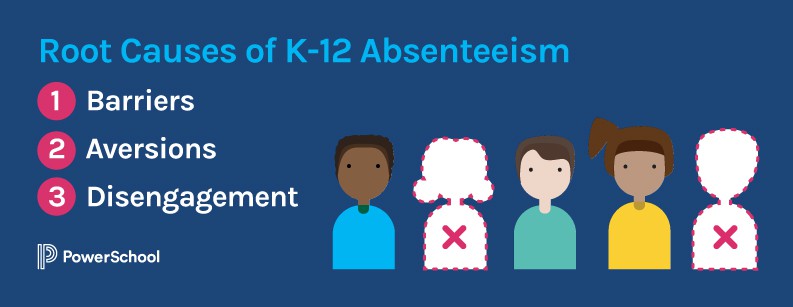
Three root causes of absenteeism:
1. Barriers:
These are restrictions keeping students from attending school. Common barriers include transportation challenges and school policies that make it more severe to be tardy than absent, so students skip an entire class when they are late. To overcome barriers, Hersh advises reducing friction. One way is by utilizing an MTSS (multi-tiered system of supports) program to identify areas in a student’s life that are considered barriers.
2. Aversions:
These are reasons that students are affirmatively repelled from coming to school or things that are pushing them away from school. Examples include bullying, where a student is afraid to go to school because of what will happen when they do come.
3. Disengagement:
Students are disengaged when nothing is drawing them to school. Involving parents via communication tools can help them engage with the student to talk about the issue.
Impacts of Absenteeism: What Happens When One Student Misses
The effects on an individual student when they miss class are both transparent and well-documented. Students who miss class experience a lower sense of belonging, as discussed above. And they don’t benefit academically from targeted learning plans, instructional materials, and education software.
- Graduation rates have dropped for the first time in 15 years; attendance is the leading indicator of graduation
- Missing just two school days a month can negatively impact academic performance
- Attendance can influence whether a student can read proficiently by the end of third grade
- Chronically absent students are less likely to graduate on time compared to their peers
But the impacts on others aren’t always as evident.
Morale goes down when other students aren’t in class, notes Hersh. At the school level, a student’s absence significantly impacts the well-being of other students.
“The emptiness of students not being there affects other students. It’s like going to a sporting event where the stands are empty. The experience is fundamentally worse for everyone,” says Hersh.
For teachers, self-confidence and self-esteem can suffer if they feel that a student’s absence may have something to do with their instruction.
And for administrative staff, their time is wasted making phone calls and sending other forms of communication to homes when the student is absent.
“There is a lot of labor dealing with the symptom that is absenteeism,” says Hersh.
Steps Districts Can Take to Identify Root Causes
Addressing chronic absenteeism in schools starts with identifying those root causes that lead to students not attending class. It’s also important to remember that absenteeism isn’t just about individual missed days. It’s a collective challenge that affects students, teachers, and the entire school ecosystem.
Understanding the root causes—including barriers, aversions, or disengagement—enables tailored solutions. Identifying and mitigating these causes through an MTSS framework that looks at multiple factors of the whole child can make strides in reducing attendance obstacles.
Watch the On-Demand Webinar
Hear more insights on chronic absenteeism, including additional ways to address the issue with solutions.
Watch Now