

Technology is most effective for teachers when data is clear and easily connected. According to PowerSchool’s 2026 EdTech Pulse study, teachers want better systems that can quickly surface student needs, streamline lesson planning, tailor professional learning, and reduce administrative burden. What they don’t need are more dashboards, disconnected reports, and convoluted data.
Appreciation for teachers includes returning teaching capacity
Teacher Appreciation Week creates a natural moment for schools, districts, and communities to pause, say thank you, and celebrate the many individuals who make a difference in students’ lives every day. We thought it would also be the perfect moment to share educator insights from our 2026 K‑12 EdTech Pulse study—specifically what teachers say they want and need most from technology.
The 2026 K‑12 EdTech Pulse was conducted by Project Tomorrow and surveyed more than 1,300 teachers, administrators, and industry leaders. Findings reinforce what many teachers already know from experience: when technology actively supports day-to-day teaching, it enables stronger focus on student learning. When it doesn’t, it contributes to growing workload and burnout.
Teachers are typically surrounded by tons of information, yet many don’t have access to insights that are timely, relevant, and usable during the school day. Too often, data arrives late, is disconnected from classroom goals, or lives in complex systems that would cost teachers too much time to dig through.
Survey respondents identified “the increasing workload of teachers beyond teaching” as the number one challenge facing teachers today, coupled with all respondents identifying teacher retention among their top three challenges. These findings point to a clear opportunity: prioritize simpler, more cohesive technology systems that reduce repetitive, manual tasks and support strategic instruction.
In this article, we explore what teachers told us they need from daily edtech and how districts can show their appreciation all year long by making these everyday systems work better for teachers.
The problem: more data, less clarity
Teachers’ roles have expanded well beyond instruction. Educators are managing academic progress, social‑emotional needs, family communication, and increasing compliance requirements—all while facing staffing shortages and rising expectations.
At the same time, districts continue to invest in technology and data systems meant to help. But teachers don’t benefit when those systems:
- Deliver data too late to inform instruction
- Require logging into multiple tools
- Prioritize reports over classroom relevance
- Focus on monitoring rather than support
The result? Data exists, but it doesn’t always help teachers in practical ways.
Why connected data systems matter:
- Teacher workload: Data that replaces manual tasks reduces administrative burden and preserves planning time.
- Teacher well‑being: Poorly designed data systems contribute to burnout and frustration.
- Personalized career support: Clear, connected data supports evaluation, tailored coaching, and professional growth.
- Student outcomes: Student data that is timely and tied to instructional goals supports stronger learning.
- Needs-based support: Early insight into student needs helps educators respond more quickly and effectively.
What do teachers say they need from technology?
The EdTech Pulse highlights a consistent theme across roles: teachers want digital supports that fit naturally into their workflow.
Real-time views, not post‑hoc reports
Educators and administrators consistently point to the value of immediate or near-immediate insights. Data that arrives weeks later may satisfy reporting requirements, but it rarely changes instruction.
What helps instead:
- Alerts that surface emerging student needs
- Real‑time views of progress or performance trends
- Data available during planning—not after grading closes
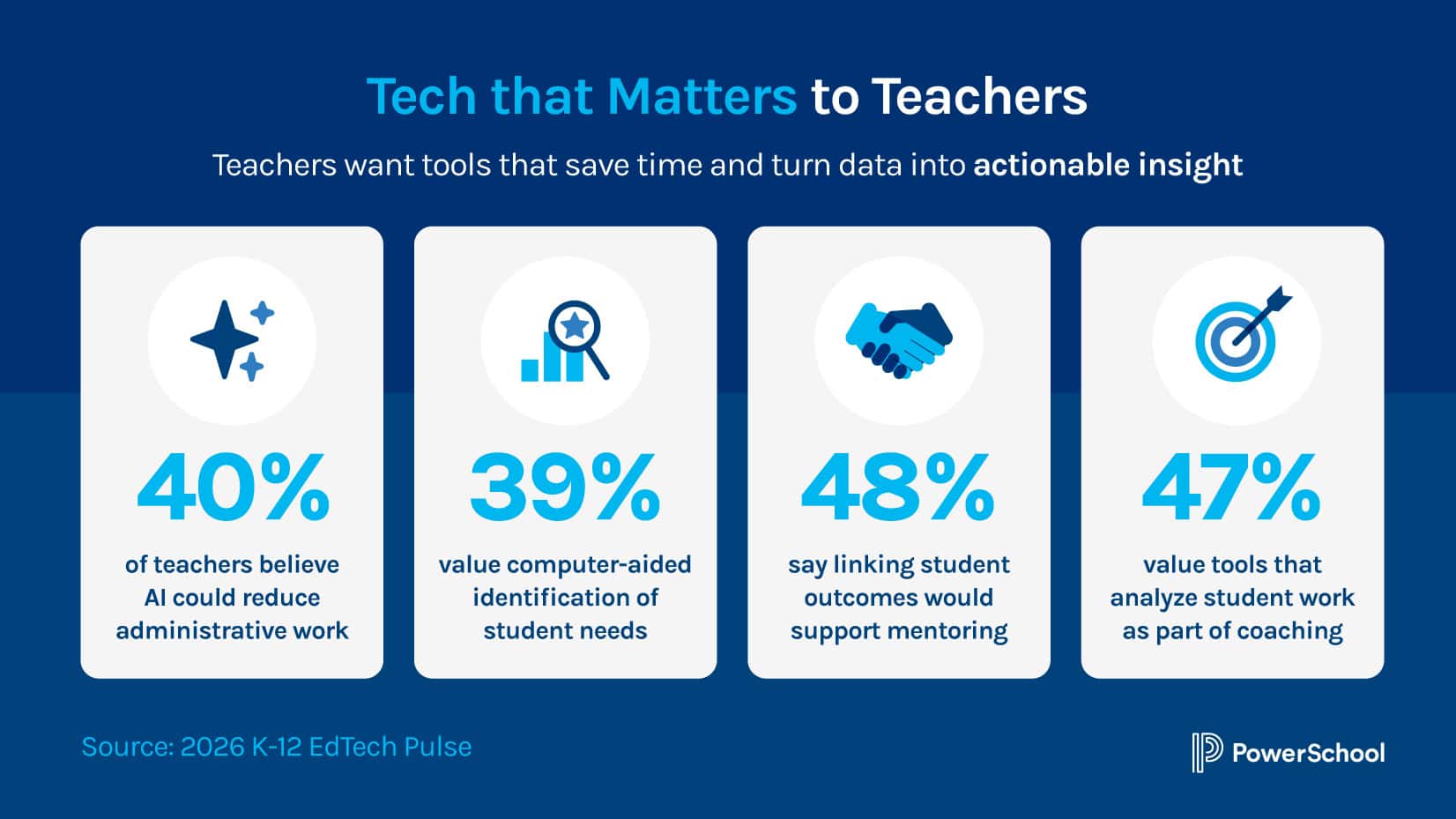
Teachers and district leaders agree. Nearly half of district administrators and 4 of 10 teachers say that using student data from digital tools to inform classroom teaching strategies would have a significant impact on teacher effectiveness.
Increased teacher workload can significantly hinder a teacher’s ability to be effective in the classroom.
Nicole Bond Director of Attendance and Enrollment
Haywood County Schools (TN)
Professional learning informed by current needs
Educators and administrators place high value on connecting student outcomes to professional growth. Nearly half of respondents say aggregating student data and linking it to professional objectives would meaningfully support coaching and mentoring.
This kind of connection allows data to:
- Inform reflective practice
- Support coaching conversations
- Reinforce career growth rather than evaluation alone
Action steps, not raw numbers
Teachers don’t need more spreadsheets. They need signals.
Educators express strong interest in tools that help identify student needs and suggest relevant actions. Computer‑aided identification of learning needs ranks high among technologies expected to impact teacher effectiveness.
Actionable data:
- Highlights priorities
- Suggests next steps
- Reduces guesswork
AI as a supporting role
According to the survey, educators see AI’s potential when it comes to streamlining administrative tasks and strengthening student-centered learning.
- About 2 in 5 classroom educators believe AI agents that reduce their procedural work will have the most significant impact on their effectiveness over the next two to four years.
- Half of teachers believe AI tools that support and personalize student learning will have the most significant impact on their effectiveness over the next two to four years.
Survey respondents also say teachers in their district are already using AI tools to:
- Create drafts, emails, or images (57%)
- Research to support tasks, lesson plans, or schoolwork (46%)
- Learn new skills with personalized AI guidance (34%)
What do teachers say they don’t need from technology?
Just as important is what teachers push back on.

Dashboards without a purpose
Customizable dashboards may interest system leaders, but teachers consistently value clarity over complexity. Data that exists “just in case” often goes unused and adds cognitive load.
Tools that add clicks, not capacity
Teachers are already managing heavy workloads. Systems that require duplicate entry, manual reconciliation, or jumping between platforms undermine trust—even if the data itself is valuable.
Data that replaces professional judgment
Educators are clear: technology should support teachers, not substitute for expertise. As leaders interviewed in the EdTech Pulse note, the most effective approaches blend digital insight with professional relationships and trust.
What can teacher appreciation look like all year long?
One of the most impactful forms of teacher appreciation is operational. Here is what that looks like in practice.
- Reduce the work around the work. Are approval processes, data entry, documentation, and handoffs pulling time away from teaching?
- Strengthen classroom support. Are behavior systems, attendance interventions, and family communication tools making daily teaching easier, or more fragmented?
- Design personalized professional learning. Give teachers formats and content they actually value: hands-on learning, mentoring, and clear classroom application.
- Be explicit about AI’s supporting role. Teachers are interested in tools that save time and support instruction, but districts need to provide guidance, examples, and training they can trust.
- Treat trust as a resource. Appreciation is most visible when teachers’ day-to-day work becomes easier and teachers see that leadership is listening.
Ultimately, when data systems work, teachers gain greater clarity—in less time—about what’s working or not working in the classroom. And that means more time for what matters most: creative planning, innovative teaching, meaningful engagement, and stronger student learning.

Improve Teacher Time
Explore how districts are simplifying data workflows so teachers can focus more time on students and less time managing systems.
Learn More